






 500,000+ readers just today.


Two major Supreme Court rulings on immigration.
Good Monday morning. I’m Isaac Saul, and I’m trying to untangle my brain after spending the last 72 hours parsing some consequential Supreme Court decisions on immigration, our main topic today. I did take enough time off this weekend to hit up my local pool, and I can safely report that public pool culture is alive and well: High-dive belly-flops, tasty french fries, and parades of screaming children abound. That should come in handy later this week, when temperatures across the East Coast, Midwest, and South are forecasted to break 100 degrees. I’ll have to figure out what to do with my walk-obsessed 18-month-old boy. Woof.
Also today: An under-the-radar story on student loans, some updates on the Iran war, and a feel-good tale of some local heroics involving a crow. It’s a 15-minute read. Time to dive in.
Quick hits.
- The Supreme Court ruled 5–4 to uphold a Mississippi state law allowing late-arriving mail-in ballots to be counted if they were postmarked by Election Day. (The first ruling) Next, the Court ruled 6–3 that President Donald Trump could remove Rebecca Kelly Slaughter from her position as a Federal Trade commissioner. (The second ruling) Finally, in a 5–4 decision, it ruled that Federal Reserve Governor Lisa Cook, whom President Trump tried to fire last year, may remain in her position as litigation continues. (The third ruling)
- U.S. officials and mediators from the Middle East said the United States and Iran had agreed to pause hostilities in the Strait of Hormuz after several days of attacks. The sides are now reportedly discussing terms for a new round of peace talks. (The latest)
- The death toll from two earthquakes that impacted Venezuela last week rose to 1,450, with tens of thousands of people still missing. (The update)
- Former national security adviser John Bolton pleaded guilty to one count of unauthorized retention of national defense information. He will be sentenced on October 28 and faces a maximum of 60 months in prison. (The plea)
- Former Transportation Secretary Pete Buttigieg shared that he and his husband were separated from their four-year-old twins for 24 hours last week after an anonymous report alleged that he posed a danger to the children. Authorities later determined the allegations were fabricated. (The incident)

What if your cravings aren't a willpower problem?
A growing body of research points somewhere unexpected: your gut. Pendulum's Metabolic Daily is built around Akkermansia muciniphila, a strain studied for its role in strengthening the gut lining, supporting digestion, and aiding GLP-1 signaling.*
Founded by PhD scientists from Johns Hopkins, Harvard, Berkeley and Stanford, it's backed by 4,500+ scientific publications, recommended by 16,000+ medical professionals, and counts Halle Berry among its endorsers.
Tangle readers can take up to 48% off their first order (HSA/FSA eligible). Discount applied automatically at checkout.
*Based on preclinical studies. This product is not intended for weight loss.
Today’s topic.
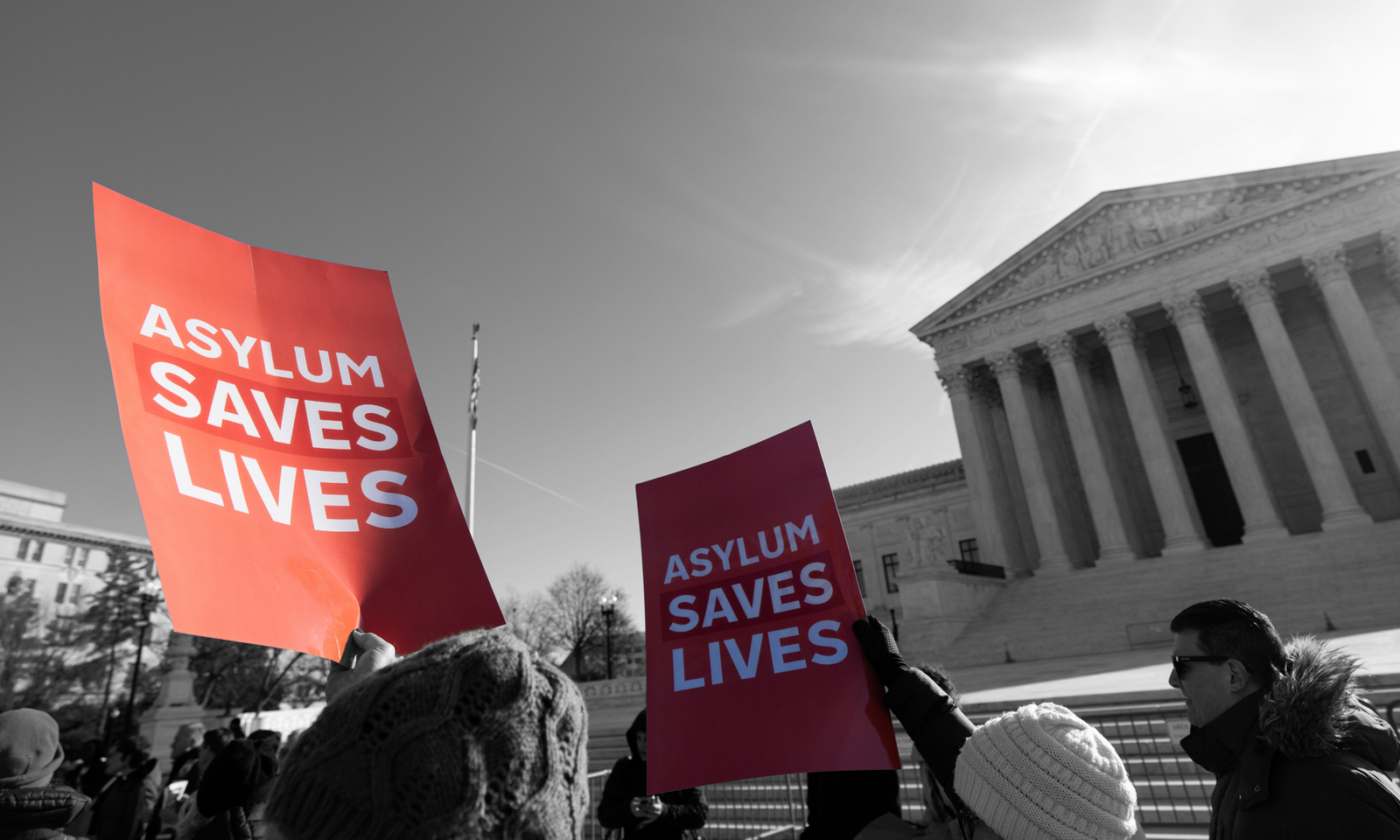
Two Supreme Court rulings on immigration. On Thursday, the Supreme Court issued two decisions on U.S. immigration policy. In the first case, Mullin v. Al Otro Lado, the Court ruled 6–3 that the federal government can turn back asylum seekers before they cross into the United States. In the second, Mullin v. Doe, the Court also ruled 6–3 that courts cannot review Department of Homeland Security (DHS) determinations on groups’ eligibility for Temporary Protected Status (TPS), clearing the way for the Trump administration to remove Haitian and Syrian TPS holders from the U.S.
The asylum case: Roughly 10 years ago, under President Barack Obama, Customs and Border Protection (CBP) officers adopted a policy called “metering,” in which they turned back noncitizens — including asylum seekers — at the U.S.–Mexico border before they could physically cross into the United States. The plaintiffs alleged this policy violated federal law allowing any person “who arrives in the United States” to access the asylum process, arguing arrival at U.S. ports of entry falls under that provision. The U.S. Court of Appeals for the 9th Circuit sided with the plaintiffs, ruling that asylum seekers who arrived at ports of entry had functionally “arrived in” the country.
The majority struck down that decision. Justice Samuel Alito wrote, “In ordinary speech, no one would say that a person ‘arrives in’ a place — for example, a house, a city, or a country — before the person enters that place,” later adding, “A running back does not arrive in the end zone when he reaches the 1-yard line.” He also noted that Congress could have specified that asylum seekers arriving at the border should have their claims heard, but it did not.
The Court’s three Democratic-appointed justices dissented, and Justice Sonia Sotomayor responded directly to several of Alito’s conclusions. “It [would not] be premature to say someone ‘arrives in’ San Francisco while she is still driving on the Golden Gate Bridge… The meanings of the phrases ‘arrives in’ and ‘arriving in’ depend on context,” she wrote. Separately, Sotomayor argued that the decision creates a “perverse incentive” because asylum seekers will now seek to enter the U.S. illegally in order to have their claims heard.
The TPS case: Congress established the Temporary Protected Status program for citizens of countries impacted by natural disaster, armed conflict, or other “extraordinary and temporary” situations. Obama administration DHS Secretary Janet Napolitano gave the designation to Haiti in 2010 following a devastating earthquake and gave the designation to Syria in 2012 amid then-President Bashar al-Assad’s violent crackdown on dissent. Those designations, which last up to 18 months at a time, were repeatedly extended until 2025, when then-DHS Secretary Kristi Noem moved to end both. Groups of Haitian and Syrian nationals challenged the decision and asked the Court to block their removal from the country while those challenges played out in lower courts.
Justice Alito, again writing for the majority, held that the law creating TPS does not permit judicial review of a DHS secretary’s decision to terminate TPS for a group. “The term ‘determination’ can be used to describe either an individual decision or the whole process leading to a final decision,” he wrote. Alito also rejected the plaintiffs’ claim that the Trump administration’s decision to end the designation was motivated by racial animus, acknowledging “heated language” used by President Donald Trump about Haitian migrants but finding that Noem could have plausibly made her decision for a litany of policy-related reasons.
The Court’s three Democratic-appointed justices again dissented. Justice Elena Kagan argued that federal law does allow judicial review of certain aspects of the TPS determination, like “the procedural steps the Secretary must undertake prior to making any determination about country conditions.” She also suggested that the Haitian plaintiffs were likely to succeed in their argument that racism was a motivating factor in the determination, violating equal protection under the Constitution.
Today, we’ll share views from the right and left on these immigration rulings. Then, Executive Editor Isaac Saul gives his take.
What the right is saying.
- The right mostly supports the rulings, with many arguing that the Court upheld the intent of the law.
- Some say the decisions rectify judicial intrusions into executive authority.
- Others say the majority erred by discounting racial animus in the TPS case.
The Washington Examiner editorial board wrote “the Supreme Court just made securing the border easier.”
“The court held that Temporary Protected Status is indeed ‘temporary,’ and that an alien is not in the United States till they are ‘in’ the United States. These simple declarations, that words mean what they say and that statutory limits must be enforced as written, will make it easier for future presidents to preserve the border security Trump has achieved,” the board said. “Open-borders activists claimed that as soon as an alien intending to enter the U.S. encounters a U.S. official at the border, even if that alien is still in Mexico, that should qualify under the statute as ‘arriving in’ the U.S. Writing for the 6–3 majority, Justice Samuel Alito was having none of it.”
“For too long, lower federal courts have treated immigration statutes not as law to be enforced, but as invitations to impose open-borders policies that Congress refused to enact… Presidents cannot secure the border if judges are free to redefine ‘in’ to mean ‘outside’ or ‘temporary’ to mean ‘permanent,’” the board wrote. “The Supreme Court restored the ordinary meaning of those words and, with it, a principle of self-government: Immigration law is written by Congress and enforced by the president, not rewritten by district court judges at the behest of activist groups.”
In The New York Post, Ilya Shapiro said “presidential power trumps leftist lawfare.”
“President Donald Trump has pushed the envelope of his authority, and the court has generally let him do so — except, as in the tariffs case, when he treads on clear congressional prerogatives,” Shapiro wrote. “The court in Mullin v. Al Otro Lado found that an alien standing in Mexico does not ‘arrive in the United States’ by attempting, and failing, to set foot in this country… That’s important, because the [Immigration and Nationality Act] gives the right to apply for asylum only to aliens who are in the country — a requirement that lower-court judges were looking to thwart.”
“The Democratic-appointed justices proved unwilling to defer to executive determinations, even those made under the discretion outlined in the INA’s text. Each time, they supported legal challenges that are actually policy disagreements,” Shapiro said. “But it’s not up to courts to make immigration determinations. Whether you like what this or any other administration does in the immigration space, Congress has legislated, for good or ill, in a way that gives expansive power to the executive branch here.”
In The Washington Post, George F. Will argued “the Supreme Court errs in this immigration ruling.”
“[DHS Secretary Kristi Noem’s] behavior egregiously violated the pertinent law, but was shielded from judicial rebuke by the court majority’s too-mechanical textualism about the secretary’s ‘determination,’ meaning decision. And by a blinkered nonrecognition of the animus behind Noem’s action,” Will wrote. “The law required Noem to review conditions in Haiti after consulting with appropriate government agencies (note the plural). Instead, she made her decision, then conducted a make-believe ‘consultation.’”
“Noem was implementing the president’s proclaimed animus even against immigrants who are in America legally, but whom he considers icky. Kagan says prior court rulings establish that the Haitians needed to show only that ‘a racially discriminatory purpose’ was ‘a motivating factor’ (emphasis added) in the termination of Haiti’s TPS designation,” Will said. “Well. Noem’s former employer has said Haitians were eating Ohio pets… Was race on the president’s mind? Donald Trump has clarified this: ‘Why is it we only take people from shithole countries’ like Haiti and Somalia? ‘Why can’t we have some people from Norway [and] Sweden?’”
What the left is saying.
- The left strongly opposes both rulings, with many saying the TPS decision was legally and morally wrong.
- Others question Alito’s textualist analysis in the asylum case.
- Still others say the laws at the root of the decisions must be changed.
In The New York Times, Elora Mukherjee called the TPS decision “a slap in the face to immigrants who followed the law.”
“Lawyers for the plaintiffs had argued in April that courts have an obligation to ensure that the TPS termination decision is not based on whims or racist ideology. In considering the challenge to the termination of TPS for Syria, on Nov. 18, 2025, Federal District Court judge Katherine Polk Failla noted that all the Trump administration terminations ‘have involved non-European, majority nonwhite populations,’” Mukherjee wrote. “Justice Elena Kagan pointed out in her dissent that Donald Trump had repeatedly used ‘repellent and racially inflected’ statements regarding immigrants — notoriously insisting Haitians are eating dogs, and baselessly commenting that Haitians in America could have AIDS.”
“The dissent further warned of the devastation that will result as TPS holders are ‘put on the next plane’ back to Haiti or Syria. TPS holders nationwide have been bracing for the worst, and now it’s here: family separations, loss of employment and deportations. In both Syria and Haiti, there is a risk of terrorism, kidnapping and armed conflict,” Mukherjee said. “As far-off as it may seem, congressional action is now the only way forward. Any new TPS statute should explicitly provide for judicial review of termination decisions, effectively overruling Thursday’s devastating Supreme Court decision.”
In Slate, Robyn Nicole Sanders said “Alito’s textualism has entered the realm of the absurd.”
“The question before the court [in the asylum case] was whether someone standing at an official port of entry on the Mexican side of the border has already ‘arrived,’ or whether arrival occurs only after physically crossing onto American soil. The court chose the latter. Under that reading, until an asylum-seeker takes that final step, the government’s statutory obligation to inspect the person and begin the asylum process never arises,” Sanders wrote. “The majority acknowledges that its reading creates some overlap in the statute but concludes that a modest amount of redundancy is preferable to giving words an unnatural meaning.”
“Justice Sonia Sotomayor’s dissent points toward [an] alternative reading. Rather than treating ‘arrives in the United States’ as a freestanding phrase, she reads it alongside the statute’s repeated mandatory commands. Congress provided that immigration officers ‘shall’ inspect arriving noncitizens and ‘shall’ refer those expressing a fear of persecution into the asylum process,” Sanders said. “Congress did not establish a system in which executive officials could decide, through physical positioning alone, whether those mandatory duties would ever arise. It established a process designed to ensure that people presenting themselves for admission at designated ports of entry would first be inspected before the government decided whether they could enter, should be removed, or allowed to pursue asylum. That reading is no less textualist.”
America Magazine’s editors suggested the rulings “reveal a profound moral failure.”
“Regarding Haitian TPS holders, in particular, [the court’s ruling] would mean returning more than 300,000 people to a country dominated by gang violence, largely without a functioning government, to which Americans are warned against traveling and to whose capital city American commercial airlines are forbidden to fly,” the editors said. “In the second case, the court allowed the administration to close the country to asylum seekers. Effectively, the court decided that the administration can refuse to allow immigrants to ‘arrive’ in the legally relevant sense at ports of entry, thus turning them away before they can even present a case for asylum under U.S. law.”
“The results of these decisions, whether or not they are legal and constitutional, are profoundly immoral and unjust. They betray the United States’ history as a country of immigrants and are a wound on the American conscience,” the editors wrote. “If the law requires allowing an administration to deport hundreds of thousands of people into mortal peril, after it has attacked them with vile and racist lies, then justice demands that the law be reformed. If the Constitution is to be interpreted to allow the president to determine in advance that effectively no one is eligible for asylum, no matter what laws Congress has passed, then the Constitution needs to be amended to strengthen the separation of powers that safeguards American liberty and self-governance.”
My take.
Reminder: “My take” is a section where we give ourselves space to share a personal opinion. If you have feedback, criticism or compliments, don't unsubscribe. Write in by replying to this email, or leave a comment.
- The majority has a strong legal argument on asylum.
- The Court’s TPS ruling is reasonable but raises practical concerns.
- Without congressional intervention, I worry the rulings will create more chaos in the immigration system.
Executive Editor Isaac Saul: Whenever I write about Supreme Court rulings, I try to separate my thoughts into two buckets: the logic of the legal arguments and the practical outcomes of the ruling. I’ll do that again today for both of these cases.
Let’s start with the asylum case. On the merits, Justice Alito’s legal rationale mostly makes sense to me. His argument about the “plain English” meaning of “arrives in” resonates with me, and his interpretation is reasonably applied here. As he noted in his opinion, immigration law frequently distinguishes between actual entrance into the U.S. and attempted entrance, so it’s fair to conclude that if Congress had wanted every asylum seeker who reached a port of entry to be able to apply for asylum, it would have said so expressly.
But Alito’s several analogies for this distinction — such as a running back reaching the one-yard line of the end zone vs. actually stepping into the end zone — didn’t sit quite right with me. I’d put it more like this: If I were invited over to a friend’s house for dinner, pulled up onto the street in front of their house and parked, then called them to say “I’ve arrived,” I would find it supremely odd if that friend said, “No, you didn’t. You’re on the street. Call me when you’re at the front door.” But if I said “I’ve arrived in your house,” then that would be odd, given that I was on the street. I might quibble with Alito’s analogies, but I think the gist of his point is sound.
On the other hand, civil rights attorney Robyn Nicole Sanders, writing in Slate (under “What the left is saying”), made a great argument that Alito’s analysis missed the full context of Congress’s intent for the asylum system. As she noted, Congress laid out clear instructions for immigration officers when someone arrives “in” the U.S., and the context of those instructions was obviously for ports of entry. The broader statute that contains this precise wording does seem to imply that Congress was making rules for what to do when someone shows up at a port of entry, not just when someone crosses into U.S. territory at a port of entry.
These semantic hairsplitting debates underscore the Court’s important role in resolving legal questions that can hinge on a word or two. Nothing about the majority’s decision feels egregiously out-of-bounds to me — in fact, on the strict interpretation of the law, I think it’s how I would have ended up voting myself. This is the law — I want it to be technical, tight, and straightforward. And in that sense, I think it’s very fair to hold the line that “arrives in” means, literally, arriving in the United States, as Alito defines it.
However, the impact of this ruling worries me. Our asylum system is broken, and metering is an effective way to slow things down. In 2024, when I laid out my bipartisan solution to fixing the immigration system, I put tightening the asylum system atop the list of Republican-led ideas I’d support. Any noncitizen (including economic migrants) can currently cross the border illegally and immediately turn themself in for processing as asylum seekers, and we have to enter them into the asylum process. Most end up not qualifying once their claims are actually heard, yet this system acts as a gigantic loophole for migrants who want to come here illegally and spend years inside the U.S. before their claims are heard (sometimes disappearing within the country once they’re inside).
I want to fix that problem, but this ruling may well make it worse. Now, rather than show up at legal ports of entry, how many more migrants will attempt to cross illegally? And how much disorganization and instability will that inject into the system? Unless Congress rewrites or amends the law, we’re likely to see more chaos — and more wild swings in policy across different administrations.
My feelings about the Temporary Protected Status (TPS) case were even more mixed.
At the base level, it would be odd if one Department of Homeland Security secretary could create and repeatedly extend TPS designations, but another couldn’t end them. TPS designations for Haitian and Syrian migrants were first made in 2010 and 2012, respectively. They were supposed to last for 18 months, but were repeatedly extended until last year, which makes a mockery of the word “temporary.” Ultimately, if former DHS Secretary Kristi Noem has determined that these TPS designations are no longer necessary or no longer serve the interests of the United States, she seems well within her legal authority to end them. Making determinations about these programs is literally the DHS secretary’s job.
But this case raises a few core legal questions, and they created a mess for the Court. One question is whether courts can actually review the determination of the DHS secretary. This seems straightforward. The TPS statute bars “judicial review of any determination of the [Secretary of Homeland Security] with respect to the designation, or termination or extension of a designation, of a foreign state.” I’m not sure how much clearer it can get, even if I find it absurd that we created a non-court-reviewable law (this should be changed immediately, lest it be further abused by this administration and future ones).
But the challengers’ claim was slightly different: They argued that while they cannot challenge the substance of Noem’s decision, they can challenge the procedure she took to get there. It’s sort of akin to saying, “Yes, I had the drugs on me, but I was illegally searched, so the charges should be thrown out.” It turns out that Noem, whose incompetence I warned about the moment she was nominated, took a quintessentially incompetent path to get to her decision. She did not adequately consult the “appropriate agencies” (the State Department) about conditions in Syria or Haiti to make her determination, as required by law. Rather than dispute whether Noem’s two email exchanges — one for each country — with a State Department official constituted a legal review, Alito simply said that the “TPS judicial-review bar expressly restricts review.” He seems right — though (again) the law’s language seems absurd — and it appears that Noem genuinely violated procedural rules to get to her predetermined conclusion.
It’s a beautiful concoction of incompetence, bad law, and inelastic jurisprudence.
Alito also concluded that a constitutional challenge to the termination of Haiti’s designation on the grounds that termination was racially motivated would likely fail. To his credit, he notes that “poverty and deprivation are no reflection on character, and there is no justification for denigrating the character of Haitians who suffer from and bear no responsibility for their country’s ills.” Still, I think the challengers had their best argument on this point. Most of us know the comments by heart now, though Justice Kagan helpfully listed them in her dissent: Trump has suggested Haitians and other immigrants were “poisoning the blood” of America, that Haitians “probably have AIDS,” that they’re “eating the dogs” and cats, that allowing them in is “like a death wish for our country.” He has also mused about why “we only take people from shithole countries” like Haiti and Somalia and not more from Norway and Sweden.
Alito’s suggestion that none of these statements was overtly racial or that they could rest on reasons that have nothing to do with race is, to me, farcical. I’m not particularly sensitive about these things in an era where far too much is chalked up to racism, sexism, antisemitism, ableism, etc. But… c’mon. Trump has used dehumanizing language specifically and repeatedly about Haiti and black-majority countries, while other majority-white countries with genuine (if lesser) instability and corruption get diplomatic courtship, business deals, and silence. We don’t have to be 100% certain that Trump is racist to make an evidentiary argument that he has racial animosity towards Haitians, and the law doesn’t require race to be the sole or dominant cause of action — only a motivating factor. Short of Trump standing up and saying, “I don’t want Haitians here because they are black,” I’m not sure what would qualify. And, frankly, “they’re poisoning the blood of our country” to describe illegal immigrants is pretty damn close.
So… now what? The practical implication is that hundreds of thousands of Haitians and thousands of Syrians who have been living here are likely to be forced to go back to their countries, or forced into hiding to avoid deportation. Meanwhile, a future Democratic administration could, say, issue a 50-year TPS for any country of its liking, and that is apparently not something any court can review, no matter how incompetently it is done.
Even on the heels of an admittedly complex set of legal questions, this outcome seems quite bad, and — without congressional intervention — the downstream effects of it will be felt long past the Trump administration.
Take the survey: What do you think of each ruling? Let us know.
Disagree? That's okay. Our opinion is just one of many. Write in and let us know why, and we'll consider publishing your feedback.
Under the radar.
On Wednesday, July 1, several changes to the federal student loan system passed under the One Big Beautiful Bill Act will take effect, including a reduction in the number of loan repayment program options and the end of the Biden administration’s Saving on a Valuable Education (SAVE) plan. New borrowers will have two repayment options — a tiered or an income-based plan — and borrowing limits for certain graduate students will be lowered. Meanwhile, people on the SAVE plan, which offered more affordable income-based repayment options, will have 90 days to apply for a new plan. Axios has a breakdown of the changes.
Spoil your pet this summer
Your pet gives you their whole heart, now give them the summer of a lifetime! The Nibbles Credit Card makes it easier than ever to give them the best.
Earn 3x rewards on everything they need: pet stores for extra treats, pet services for boarding and grooming, and even vet visits. Plus, the Nibbles card comes with pet insurance included! Combine this all with no annual fee, it’s the ultimate way to pamper and protect your pet.
*Nibbles is not a bank. The Nibbles Card is issued by Lead Bank. Other fees and T&Cs apply. Rewards & pet insurance offered by Nibbles, not Lead Bank. Base pet insurance policy paid for one eligible pet by Nibbles. See nibbles.com for details. Nibbles does not operate in CT, NY, KY, MN, WA, CO, HI, MA, or ME.
Numbers.
- 1.3 million. The approximate number of people with Temporary Protected Status (TPS) living in the United States as of March 2025.
- 330,735. The number of Haitians with TPS living in the U.S. as of March 2025.
- 3,860. The number of Syrians with TPS living in the U.S. as of March 2025.
- 54,400. The approximate number of people granted asylum in the United States in fiscal year 2023.
- 7,500. The refugee admission cap set by the Trump administration for fiscal year 2026, the lowest in the U.S. refugee resettlement program’s 45-year history.
The extras.
- One year ago today we had just published Editor-at-Large Kmele Foster’s essay on having an authentic racial reckoning.
- The most clicked link in our last regular newsletter was an article on why mosquitoes bite some people more than others.
- Nothing to do with politics: If you’re one of those unlucky mosquito magnets, here’s why you should avoid scratching those bites.
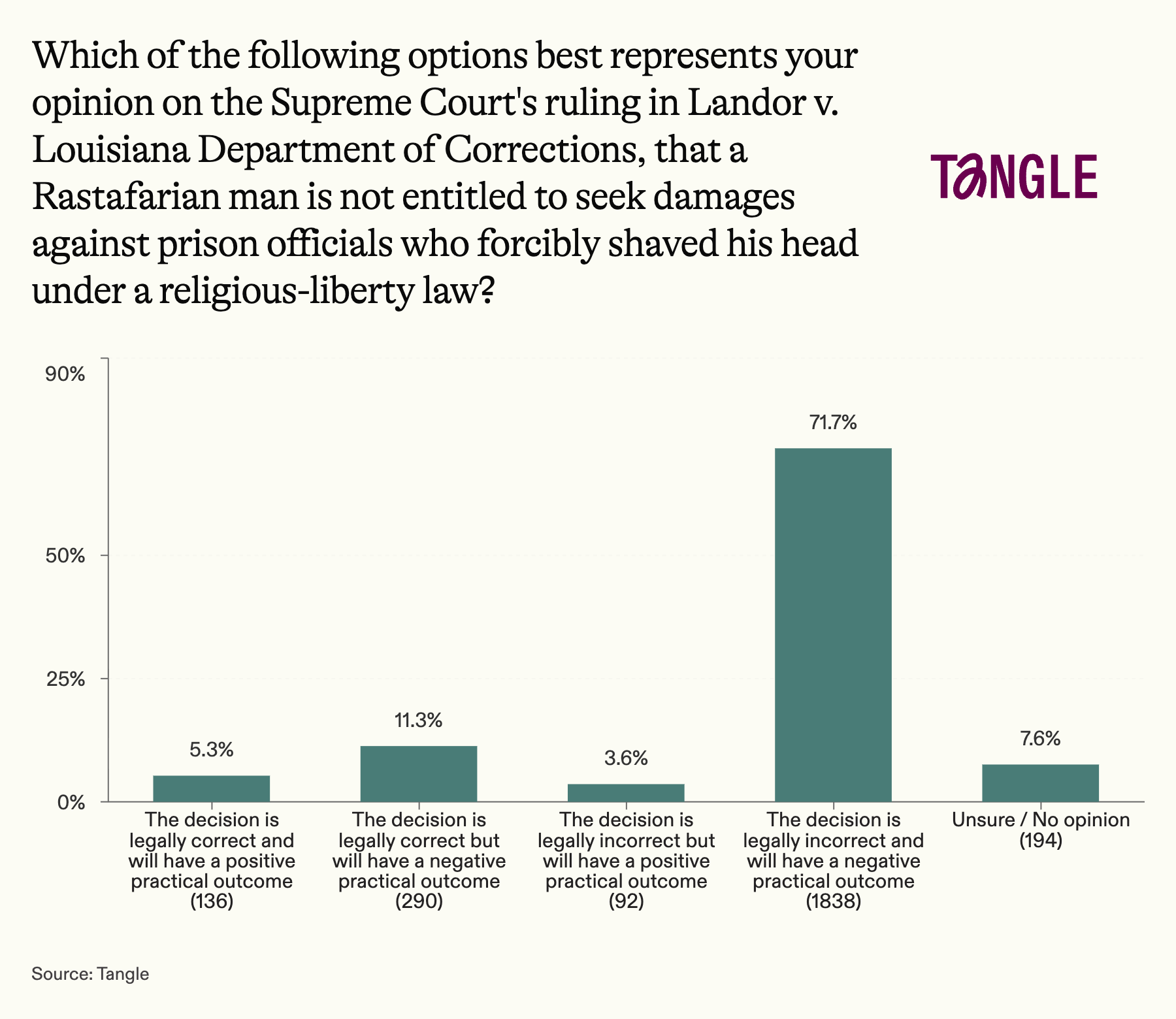
- Our last survey: 2,563 readers responded to our survey on the Supreme Court’s religious liberties ruling, with 72% saying the decision was legally incorrect and will have a negative effect. “Once again, SCOTUS demonstrates that it has become a political body, and not an independent arena for decisions based on law,” one respondent said. “The Court gave Congress a roadmap on how to fix this,” said another.
Have a nice day.
Initially, Leah Wilson had no idea why the sky above her house was full of crows. Then, she and her neighbors discovered that a crow had become stuck in her home’s gutter. She enlisted the help of the local fire department to save the bird, then drove it to a wild animal rehabilitation center. A few days later, the center told her that the crow had been released back into the wild. But that wasn’t the end of the story. When walking her dog around the neighborhood, Wilson says a crow swooped down and dropped a feathered bundle at her feet. Since then, crows have left her more than half a dozen items — and they often join her on her walks with her dog. CP24 has the story.