















 500,000+ readers just today.


The FlyDubai plane attack.
Good Tuesday morning and welcome to Tangle. I’m Isaac Saul, back again today as your news shaman — ready to guide you through the weird wacky wild world of stupid internet reactions. We’ll be diving into the attempted hijacking of a FlyDubai plane headed to Israel and two big conspir — excuse me, stories — that came out of it.
Plus, a reader question about polls motivating voters’ decisions and a feel-good story about one man’s mission to improve New York’s basketball courts.
It’s a 12-minute read.
Ari Weitzman, Will Kaback, Audrey Moorehead, Carina Pacheco, Russell Nystrom, Isaac Wood, and Bailey Saul edited or contributed to today’s newsletter.

Election season is here.
As we gear up for election season, we need your support. Our team is now 13 people strong, and we’re preparing for the biggest few months of the year.
The best way to help us is to become a member. It costs less than $5/month when you sign up for the year, and it unlocks members-only content, ad-free newsletters, and automatic access to all our new products.
Quick hits.
- The Supreme Court began its new term, hearing arguments in a case centered on efforts by the city and county of Boulder, Colorado, to sue two energy companies for damages related to the costs of climate change. The Court is considering whether federal law blocks the city and county from bringing its suit. (The case)
- Former Rep. Dennis Hastert (R-IL), the longest-serving Republican Speaker of the House, died at 84. In 2015, Hastert pleaded guilty to financial crimes related to efforts to cover up allegations that he had sexually abused boys as a high school wrestling coach decades earlier. (The death)
- Paramount Skydance finalized its $110 billion acquisition of Warner Bros. Discovery. (The acquisition)
- President Donald Trump said that he will no longer use government funds to pay for national television ads promoting his presidency and will instead use funds from his super PAC. (The statement)
- Pentagon Spokesman Sean Parnell announced that President Trump approved a recommendation to execute a former Army major by U.S. Army firing squad, which would be the first U.S. military execution since 1961. The man killed 13 people and wounded 32 in a 2009 mass shooting at Fort Hood. (The announcement)
The stocking stuffer you’ll wish you had bought for yourself.
There are few modern-day heartbreaks worse than seeing 2% battery when you’re nowhere near a power outlet. Enter the Ultra-thin Wireless ChargeCard: the ridiculously slim magnetic charger that fits in your wallet, so you can carry backup power everywhere without carrying those big bulky chargers. At just 0.3 inches thin, this is ultimate convenience!
Think of it as a safety net for your phone… minus the big, bulky brick and tangled cords. Just pull it out from your wallet, snap it on your phone magnetically and stay powered all day and night. Made by a SHARK TANK company, there’s a reason this brilliant little gadget has been featured in Forbes, Fox and many more.
Give the holiday gift everyone will be talking about. Never see 2% again.
Tangle readers get 40% off with promo code TANGLE40.
Today’s topic.
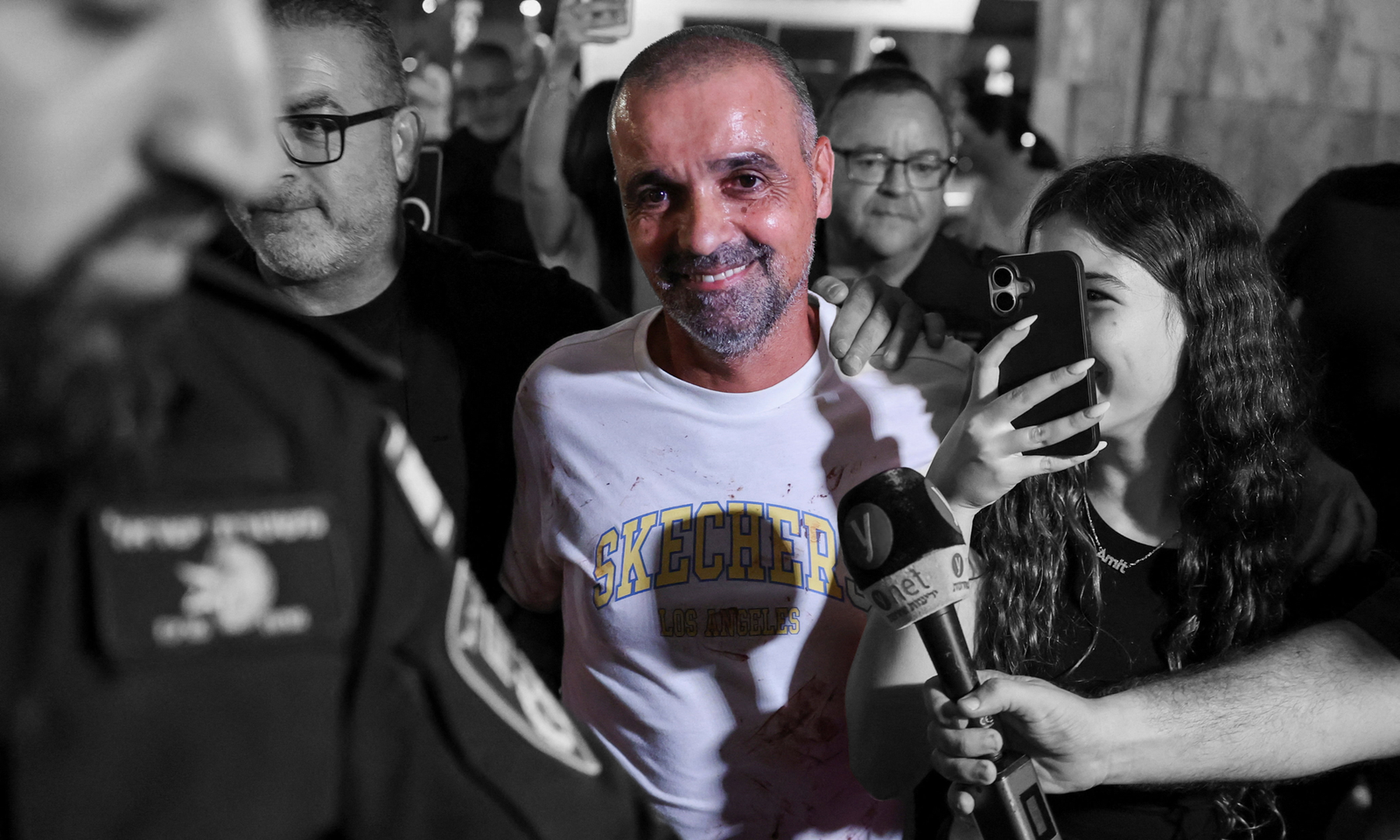
The FlyDubai attack. On Wednesday, the copilot of a FlyDubai commercial flight from Dubai to Tel Aviv allegedly attacked the plane’s captain and attempted to crash the aircraft in what Israeli officials have deemed an attempted terrorist attack. The captain, Smit Machchhar of India, was stabbed multiple times and seriously wounded but managed to open the cockpit door, allowing crew and passengers to detain the copilot. Two pilots on board as passengers then took control of the aircraft and landed it safely in Tabuk, Saudi Arabia. The attacker has been identified as an Omani national and is currently in custody in the United Arab Emirates (UAE).
During the attack, the Boeing 737 MAX aircraft was subjected to extreme forces that exceeded its operational limits. The plane descended at a 39-degree angle (compared with a 3-degree angle in a standard descent), falling 17,400 feet in 92 seconds. When the other pilots on board managed to regain control, the aircraft lost part of its tail rudder, causing partial loss of control. The pilots kept the plane airborne for approximately one hour before landing at Tabuk Airport.
A preliminary investigation has reportedly found that the copilot intended to take control of the aircraft and crash it into Israel’s Ben Gurion International Airport. Reuters also reported that the suspect operated a flight to Tel Aviv earlier this year with a similar goal of hijacking and crashing the aircraft but abandoned the plan for unknown reasons. Law enforcement officials said he had been suspended from flying by Oman Air in 2024 after he was found in possession of extremist materials.
Israeli Prime Minister Benjamin Netanyahu said intelligence officials determined the copilot had undergone “Islamist radical indoctrination,” but his precise motive is still unknown. Separately, United Arab Emirates Attorney General Hamad Saif Al Shamsi confirmed the hijacking was an attempted terrorist attack.
Today, we’ll share views from the right, left and Israeli writers, followed by Executive Editor Isaac Saul’s take.
|
What the right is saying.
|
In The Free Press, Douglas Murray suggested “Israel is winning.”
“Most of all, the attack — and the successful averting of what could have been a mass-casualty terrorist event — is a reminder of something bigger: that Israel and the West remain at war with Islamic radicals, and that it is a war we are winning,” Murray wrote. “To some people, this reflection might seem counterintuitive. Each day’s news is filled with declarations of defeat. The online world is filled with shrill declarations that Israel has lost this war.
“With the hindsight of three years of war, we can now see more clearly how complete the devastation of Iran’s plans has been. Piece by piece, the government of Benjamin Netanyahu took apart the Iranian axis,” Murray said. “What happened in the skies above Saudi Arabia on Wednesday morning stands as a metaphor for three years of war. The Israelis saw an existential threat, took matters into their own hands, and decided their own course.”
In The Hill, Becket Adams argued that “caution is selective” among the news media.
“When it comes to crisis events, a cautious pose is always the smart play for a news organization. You never want to get ahead of the story — to prioritize being first ahead of being right,” Adams wrote. “But the care shown on this foiled hijacking story could not contrast more sharply with the Western press’s regular mishandling of allegations against Israel. The New York Times has, in particular, racked up a rather ignoble record in this area.
“The Times was among the first in October 2023 to misreport that Israel had bombed the Al-Ahli Arab Hospital, killing 500. Israel did no such thing. The rocket was misfired by the terrorist group Islamic Jihad, according to a U.S. assessment, and it did not even hit the hospital,” Adams said. “It is good, heartening even, that the Times handled last week’s foiled hijacking with care and caution… But where is this same seriousness when the allegations are directed at Israel?”
|
What the left is saying.
|
In The Atlantic, Graeme Wood said the incident has “huge implications.”
“Whether today’s near disaster was terrorism or merely attempted mass murder depends on the attacker’s motive. Either way, it is a public-relations catastrophe for Flydubai… Since the United Arab Emirates opened diplomatic relations with Israel in 2020, the airline has connected the two countries with few interruptions, even for acts of war and terror,” Wood wrote. “One possible political motive for the Flydubai incident would be to strain and punish the relationship between the two countries.”
“The next step will involve determining whether the pilot acted alone — not a good look for Flydubai, to have suicidal or terrorist pilots — or at someone’s behest. The latter possibility could, if confirmed, have serious implications, depending on who directed the attack,” Wood said. “Many have a motive: Sunni jihadists (al-Qaeda or the Islamic State), Hamas, and of course Iran and its proxies. This Mayday moment will have huge implications if any of these groups are involved.”
In The Forward, Dan Perry wrote “for a few terrifying minutes, Israelis were heroes again.”
“There is something refreshing about the simplicity of the story. The passengers were confronted with a danger that required immediate action, and some of them acted. Israelis watching the story unfold saw a familiar national trait emerge in circumstances where slogans had very little use,” Perry said. “For Israelis, that quality has long been part of the national mythology. The country was built around the idea that its people would have to improvise their way through circumstances that seemed to offer very little room for error.”
“Sadly, much of the world has encountered a very different Israeli stereotype in recent years. Israelis have increasingly become symbols in arguments about war, occupation, nationalism and international law,” Perry wrote. “Then came the FlyDubai flight… Israelis have been seen increasingly through the prism of the Israeli-Palestinian conflict, and sometimes through the actions of the government that happens to represent them. A plane full of passengers offers a different perspective.”
|
What Israeli writers are saying.
|
In JNS, Fiamma Nirenstein said “heroic Israelis avert a new 9/11.”
“If there had not been ordinary Israelis on vacation aboard that plane, with their determined and well-organized will to survive, the world today might have been facing a new 9/11 in Tel Aviv,” Nirenstein wrote. “The alleged attacker was Omani. Oman has close relations with Iran, which maintains a strategic interest in the country because of its position overlooking the Strait of Hormuz and the entrance to the Persian Gulf.
“The captain he allegedly attacked, by contrast, is a citizen of the United Arab Emirates — a friendly Arab country that signed the Abraham Accords with Israel,” Nirenstein said. “The contrast could hardly have been sharper: an alleged attacker apparently seeking destruction and an Emirati crew working alongside Israeli passengers to save lives. The passengers fought. The cabin crew helped them. Other pilots took control. Arabs and Israelis together prevented catastrophe.”
In The Jerusalem Post, Ben Caspit wrote “our security agencies… failed miserably.”
“A major failure occurred here — a massive one. A pilot — one whom Oman grounded for becoming radicalized and whom Morocco barred from flying due to his extremist Islamist views — found himself flying hundreds of Israelis to Israel,” Caspit wrote. “The Mossad has no way of knowing about every single jihadist who decides to kill Jews, provided that individual isn’t linked to an organized group or acting on orders from somewhere. If that is indeed the case, the Mossad bears less responsibility here.
“And yet, an Omani pilot – deemed ‘dangerous’ by the Omanis themselves – should not be flying to Israel without that information coming to the attention of Israeli authorities,” Caspit said. “Wherever Israeli flights take off from, there are always Israeli security personnel responsible for perimeter security… They operate alongside deep intelligence support, cooperation with local security forces, the vetting of anyone coming into contact with passenger security, and so on. They were there, and yet — it happened.”
|
||||
|
||||
|
Reminder: This is where we share a personal opinion. If you have feedback, criticism or compliments, leave a comment or reply to this email.
|

As news broke of the attempted terrorist attack on the FlyDubai plane, two other stories broke with it.
First was a controversy over how the story was reported. Prominent pundits, many on the right, criticized a New York Times tweet early on the morning of the attempted hijacking which read, “Breaking news: A plane flying from Dubai to Israel was diverted after an altercation between the pilot and co-pilot, Israeli officials said.” Other outlets had similarly ambiguous language. The BBC reported an “Israel-bound flight diverted after fight between pilots.” CTV News headlined its coverage, “Commercial flight from Dubai diverted, briefly raising hijacking concerns and prompting Israel to scramble warplanes.” Critics suggested this was an effort to obscure or downplay an attempt on Israeli lives — an obfuscation that might reinforce the dangers that Israelis face daily.
The second controversy unfolded days later. Conspiracy theories exploded — predominantly on the left — suggesting the entire incident was a “false flag.” Perhaps the goal was to inspire national unity, or somehow make Netanyahu look good, or maybe use the event as an excuse for more national security. Ana Kasparian, who was a featured guest at last year’s “Tangle Live” event in Irvine, California, suggested that it was “weird” how “just yesterday Netanyahu was saying that the Iranians are going to carry out some sort of attack against Israel,” and “everyone was saying, ‘uh oh, here comes the false flag.’” She offered that she was “not suggesting” it was a false flag because she “doesn’t know yet,” but she thinks “it’s fishy.” Her co-host Cenk Uygur was less suggestive, using a segment to explain what “actually” happened with the FlyDubai plane, “how these things are done,” and “why might it be a false flag.” He went on to suggest that “they” might have found a mentally ill guy and allowed him to get on the plane with a knife.
Both narratives bothered me for very different reasons.
For starters, I don’t think there was anything wrong with the New York Times’ tweet. A lot of people don’t seem to understand how original reporting is done. When news breaks of a plane being diverted, and social media posts explode with claims of a struggle in the cockpit or a hijacking, an outlet like The New York Times is not going to report that without independent corroboration. Their job, as the paper of record, is to be careful — to be sure — not to amplify internet rumors. They’d never put something in print without at least getting some sources of their own.
Also, the Times’ reporting was not obscuring anything. As I documented on X, the offending social media post linked to a live page with updates. Before and after that tweet went out, The Times updated the story on that page, including comments from Israeli officials and the prime minister’s office discussing an attempted hijacking. It also made subsequent posts on X as it confirmed more details. Even under cynical reasoning, this particular criticism is nonsensical. If The Times could have been the first paper to report a hijacking of a plane full of Israelis to its audience — a story that would drive a boom in pageviews, subscribers, and citations — it would have.
The worst thing you can say about the paper and its journalists, which is a legitimate criticism, is that it has blasted out headlines (like the claim Israel killed 500 people bombing the al-Ahli Arab Hospital) based solely on Palestinian sources. I wrote an entire article criticizing the shoddy work of the hospital-attack story, and (predictably) The Times’ story completely fell apart. But the lesson from that incident isn’t to report faster or report more confidently based on potentially biased sources. The lesson is to be more careful to slow down and get it right. That’s what the Times did here, and nothing about its reporting was unethical or wrong.
The other narrative, the one propagated by Kasparian and Uygur, was deeply disappointing. I like Ana, and I think she offers a lot of value as an independent political voice. But here, she offered an example of how deranged commentary about Israel has become. Kasparian and Uygur essentially speculated this attack was a false flag because it closely followed Netanyahu’s comments. Others are holding up even thinner evidence: Some X users claimed that the details of the story — from passengers getting into the cockpit to oxygen masks not deploying to the pictures of cups of water — indicate a conspiracy. These claims give off “jet fuel can’t melt steel beams so 9/11 was an inside job” vibes, and they are all easily debunkable.
The story here is simple, even if it makes many people who distrust Israel very uncomfortable: There are people in the Middle East who want to kill Israelis and Jews. Examples of this kind of terrorism against Israelis and Jews are copious, and the FlyDubai example comes with copious videos, images, and firsthand accounts of bloodied pilots and passengers rushing the cockpit. All these details corroborate the story being reported not just in Israel or the United States but across the globe.
While information is still limited and in some cases vague, reporting about this copilot is pretty damning so far. He is an Omani national who was previously suspended from flying on Oman Air because he was deemed a security risk after being found in possession of extremist materials. His deleted social media posts pointed to “intense religious conservatism and misogyny,” ABC News reported.
Also, he took an axe to his copilot and tried to down a plane with 174 passengers on board.
An investigation will give us concrete details about what motivated the attack, but I don’t think we need to pretend the pieces are hard to put together. If anything doesn’t add up here, it’s how FlyDubai allowed this pilot in the cockpit at all. The UAE’s Attorney General Hamad Saif Al Shamsi — read: not an Israeli official — said on Saturday that it was an attempted act of terrorism. The attacker is an Omani national. Oman’s population is 95% Muslim. Israel is currently in live conflicts with several Muslim-majority nations throughout the region. The precise motivations will be fleshed out in an investigation, but I feel comfortable speculating that Islamic extremism, the conflicts in the Middle East, or some combination of the two will be involved. It is self-evident who the targets were.
In July, I wrote about how conspiracy theories are getting dumber. I’d argue both of these narratives add to the list of examples I shared in that piece. The New York Times is not avoiding front-page news it could break to the world because it’s scared to make Israel look like a victim. And Israel does not need to create false flag operations endangering its own citizens to create a mirage of danger — the danger is real, and Israelis live it every day.
Take the survey: What’s your view on the incident? Let us know.
Disagree? That’s okay. Our opinion is just one of many. Write in and let us know why, and we’ll consider publishing your feedback.
Your questions, answered.
My girlfriend and I were talking about a recent election and she said “I’d like to vote for this candidate but they aren’t polling well so I will vote for so and so, who is ahead.” And it made me think, do polls sway voters’ decisions in a meaningful way? This seems problematic for a number of reasons.
— u/franticallyfarting, Tangle subreddit
Managing Editor Ari Weitzman: A very astute question from someone with a very erudite name — and timely, too.
As far back as 1979, researchers have found that voters tend to favor candidates who poll well. More recently, in 2020, researchers at UCLA affirmed this “bandwagon effect” — that voters are biased towards candidates they think can win. They found this by looking at multi-round French elections from 1958 to 2017 and seeing that voters tended to overwhelmingly support first-round winners, even when they advanced on small margins.
Of course, France’s system is very different from ours. Multiple candidates can advance from France’s first round, which is similar to party primaries. But rather than participating in disparate voting pools, all French voters take part in each round — meaning extrapolating from there is difficult. It’s quite possible that American voters would be happy to punch a ballot for a candidate they are less confident of in the earlier round, if they know they could vote against “the other guy” in the general election.
This bandwagon effect based on polling may or may not impact voters at scale — we can’t say for sure — but we do know that it impacts a certain influential subset of the electorate: donors. Harvard researchers described this “vicious cycle” in 2013: A candidate polls well, so donors hoping to curry influence back the winner, which helps that candidate campaign more effectively, which makes them poll well, which attracts donors, etc. We then saw this play out famously in 2016, when Hillary Clinton beat Bernie Sanders in the Democratic primary, partly due to “electability” concerns.
Whether or not voters fall in line with this bandwagon effect, campaigns (and their donors) are certainly subject to it themselves. It’s one of the many pitfalls to watch for when interpreting campaign polling.
Want to have a question answered in the newsletter? You can reply to this email (it goes straight to our inbox) or fill out this form.
Life’s too short for gifts that end up in a junk drawer. Give something they’ll actually use every day. The Wireless ChargeCard slips into a wallet and delivers backup power when they need it most. Clever, ultra-convenient and insanely useful… the rare gift that makes everyone wonder, “Where has this been?”
Tangle readers save 40% today with code TANGLE40.
The extras.
- One year ago today we covered federal troop deployments in Chicago and Portland.
- The most clicked link in our last regular newsletter was our Friday edition on the global fertility decline.
- Nothing to do with politics: Blow off some digital steam with Destroy Any Website.
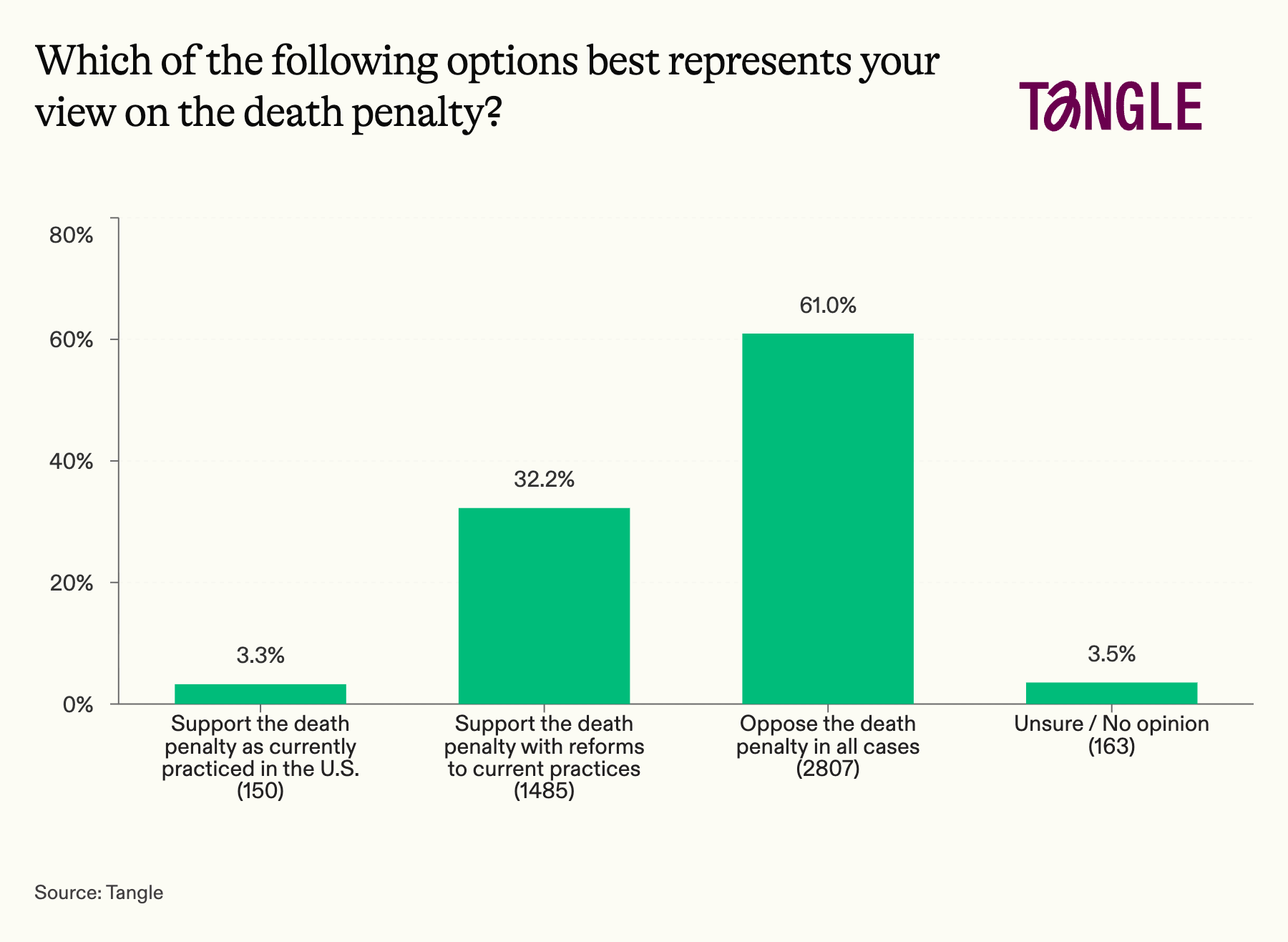
- Our last survey: 4,605 readers responded to our survey on Christa Pike and the death penalty, with 61% saying they oppose the death penalty in all cases. “If even one person might accidentally be put to death, then it is wrong,” one respondent said. “The death penalty is not morally wrong when applied to the most heinous criminals in our country,” said another.
Have a nice day.
New York City resident Craig Campanella loves the swoosh of a made shot, but one day he noticed frayed nets at the basketball court near his home. They would deteriorate and not be replaced for months. So he started replacing the nylon nets himself. Campanella gave himself a goal of installing 25 nets this year, and surpassed it in six months; now, he’s set a new goal of 50 for the year. “Putting nets on hoops isn’t going to necessarily solve the world’s problems,” he said. “But it’s something I can do. It’s tangible. It makes me smile, and it makes other people in the park smile, and so I just do it.” The City Reporter has the story.