















 500,000+ readers just today.




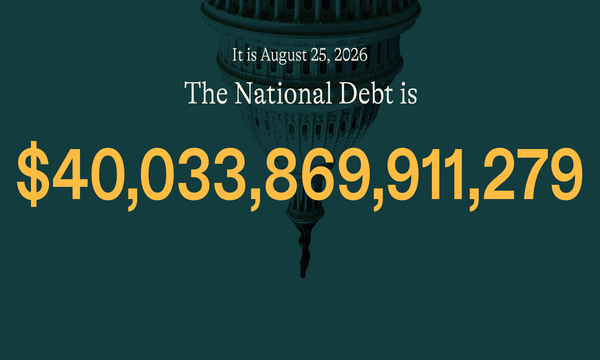
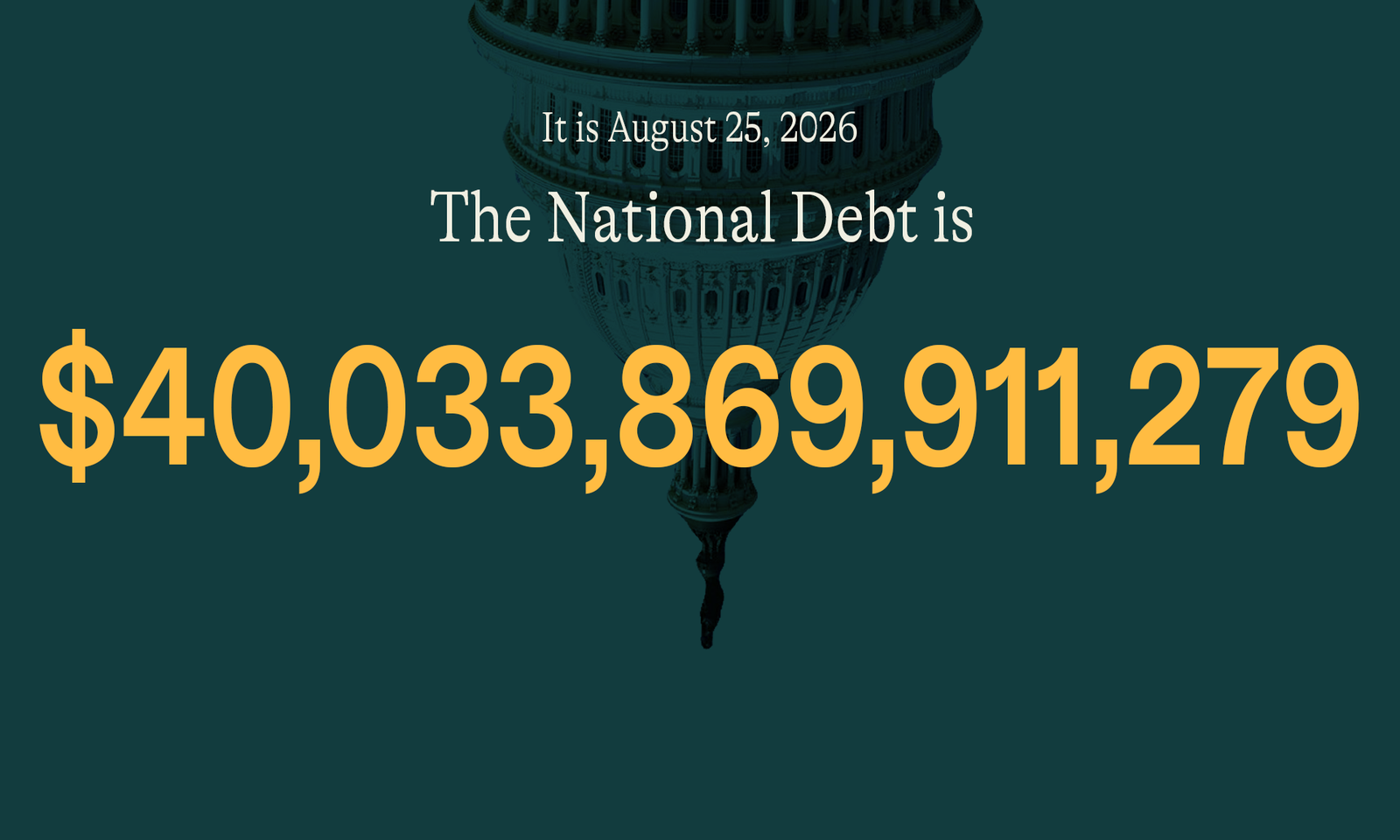
The national debt hits $40 trillion.
Good Tyrsday to you all. This is Managing Editor Ari Weitzman, here with my long sleeves on watching the mist roll back over the Adirondacks. I’m resisting the urge to get too autumnal too soon, but man — there’s nothing like a New England fall. The apple, it yearns for the picking; the cider press, it yearns for the apple; the managing editor, he yearns for the cider.
I’m feeling very grateful today. Indebted, if you will. Perhaps, as our national debt reaches an auspicious milestone, we should all feel that way. In today’s edition, I’m going to talk about why our debt is high and why it’s not going anywhere, then we’ll give a look back at debt in the early Republic. It’s a 13-minute read (25 minutes when adjusted for inflation).
Applications are open.
For the past three years, Tangle has run a college ambassador program, offering current college students the chance to serve as Tangle’s liaison on their campus, organizing speaking events, clubs, class talks, and more. Applications are now open for the fall semester program. If you (or someone you know) is interested in applying, you can do so here.
We are accepting applications until Wednesday, September 2 at 11:59 PM ET. Please email Will Kaback at will@readtangle.com with any questions.
Quick hits.
- BREAKING: The Canadian government announced tariffs ranging from 15%–50% on approximately $20 billion worth of U.S. imports in retaliation for U.S. duties imposed on Saturday. Canada's tariffs will take effect on September 8. (The tariffs)
- The Supreme Court issued an unsigned emergency order staying a lower court injunction on President Donald Trump’s executive order on mail-in ballots, which would direct the U.S. Postal Service to create lists of eligible voters in each state and possibly restrict delivery of mail-in ballots in states that do not cooperate. The majority found that a multi-state challenge to the action was premature because the order is yet to be implemented but allowed for subsequent challenges to possibly succeed. The Court’s three Democratic-appointed justices dissented. However, a separate federal injunction on the executive order remains in place. (The ruling)
- Treasury Secretary Scott Bessent announced “Operation Economic Outcast” to sanction countries that do business with Iran in an effort to cut Iran off from the global economy. Bessent said these secondary sanctions would not immediately go into effect, calling the announcement a “warning shot.” (The announcement)
- U.S. Southern Command said the military struck a boat in the Pacific Ocean that was allegedly trafficking drugs, killing two people. (The strike)
- A significant wildfire near Reno, Nevada, is 27% contained as of Monday, according to local officials. The fire has injured seven people, destroyed over 30 homes, and forced approximately 63,000 people to evacuate the area. (The fire)
- An independent arbitrator ruled that The Washington Post wrongfully terminated former opinion columnist Karen Attiah over social media posts related to the assassination of conservative activist Charlie Kirk, ordering the paper to reinstate her with back pay. (The order)
Is Your Car Insurance Getting Expensive?
You could be wasting hundreds every year on expensive insurance. The experts at SmarterAuto believe they can help. If your rate went up in the last 12 months, check out this new tool from SmarterAuto to see if you’re overpaying in just a few clicks!
They match drivers with companies reporting savings of $600 or more per year when switching! Plus, once you use it, you’ll always have access to the lowest rates; best yet, it’s free. Answer a few easy questions to see how much you could be saving.
Today’s topic.
The national debt. On Tuesday, August 18, the Treasury Department announced that the debt held by the U.S. government surpassed $40 trillion, a record high. The national debt has more than doubled since 2017, and it increased from $39 trillion to $40 trillion in roughly the past five months. In response to the latest milestone, lawmakers from both parties called for new initiatives to reduce the debt.
Back up: The national debt is the total amount of money the U.S. government owes, whereas the national deficit is the net annual difference between government expenditures and revenues. In other words, the debt represents the sum of past deficits (minus any annual surpluses, which the government has run only four times in the past 50 years). Economists hold differing views on the importance of the national debt, but in recent years, a growing consensus has held that both the debt and deficit will create long-term challenges for the United States if fiscal trends continue.
Most federal spending goes toward individual benefit programs like Social Security and Medicare, in addition to national defense spending and debt interest payments. Annual spending has remained high or increased in the past two decades, while Congress has also approved multi–trillion-dollar additional spending packages in response to the Covid-19 pandemic. Simultaneously, Congress has cut individual and corporate tax rates.
Beyond the $40 trillion debt milestone, economists have raised concerns about the amount of debt held by the U.S. public (which excludes debt government departments owe other departments, in particular the Social Security trust fund) and the ratio of debt to gross domestic product (GDP). In 2001, publicly held debt as a share of GDP was 31.5%; today, it is nearly 100%.
In response to last week’s Treasury announcement, Republican fiscal hawks called for urgent action to curtail spending. “America’s national debt has officially crossed a line that should alarm every single American,” Rep. Ralph Norman (R-SC) wrote on X. “This is not just another number. It is a flashing warning sign that Washington’s reckless, unchecked spending is putting the future of our country, and generations of Americans, at risk.”
Democrats also expressed alarm, with many blaming President Donald Trump’s policies for the worsening situation. “For a President and a Republican Party who have railed for years against the nation’s debt, it’s ironic that America is deeper than ever in the red under their leadership,” Sen. Dick Durbin (D-IL) said. “From Trump’s billionaire tax cuts to his war with Iran, it’s clear fiscal responsibility is the last thing on his mind.”
Treasury Secretary Scott Bessent suggested the $40 trillion figure was not a cause for unique concern. “There’s nothing magic about the 40-trillion number,” he said. “We can grow our way out of that.” Bessent also said he thinks there is a “very good chance” the deficit under the second Trump administration has peaked.
Today, we’ll hear views from the left and right about the national debt. Then, Managing Editor Ari Weitzman gives his take.
|
Agreed.
Writers across the political spectrum agree that the rising national debt is a problem requiring action from elected officials.
|
|
What the left is saying.
|
In MS NOW, Steve Benen wrote “Trump has some explaining to do.”
“The problem is getting worse faster than anyone expected,” Benen said. “As a candidate in 2024, [Trump] repeated his earlier promises [to reduce the deficit and start paying off the debt], before again delivering the opposite results: Trump has added nearly $4 trillion in debt since returning to the White House a year and a half ago. Trump and congressional Republicans are to blame: There’s no great mystery here. The debt is growing quickly as a direct result of GOP policies, including last year’s tax breaks for the wealthy and the war in Iran.”
“For decades, Republican officials have expressed hysterical concerns about ‘fiscal responsibility’ every time there’s been a Democratic president… The gap between what the government spends and what it takes in, GOP officials said, threatened to bankrupt the nation, crash the economy and ruin the lives of our children and grandchildren,” Benen wrote. “But as this year’s deficit approaches the $2 trillion mark, and the debt passes the $40 trillion mark, those same Republicans are suddenly silent on the issue.”
In Common Dreams, Dean Baker argued “the more important issue is to have a healthy economy with solid growth.”
“I have never been a deficit hawk, and I’m not about to change my religious affiliation now. But whatever we think of debt and deficits, there is one point that should be very clear: it has been run up almost entirely due to Republican tax cuts and their inept management of the economy,” Baker wrote. “Every Democratic president of the last half century has left with a deficit that was lower, measured as a share of GDP, than the one they came in with, except Obama, who left it unchanged. By contrast, every Republican president has left with a considerably higher deficit than what they inherited.”
“Here is where the big failure is. Trump’s war is leading to shortages… His tariffs have led to higher prices for a wide range of products, as has his mass deportations. Perhaps most importantly, Trump’s open corruption and self-dealing undermine confidence in the U.S. financial markets and business system more generally,” Baker said. “In the past, investors could view the United States markets as relatively clean and stable. Unlike in some other countries, getting your investment back didn’t depend on staying in the good graces of the political leadership. Under Trump, this is no longer true… That is not a good recipe for a stable economy with solid growth.”
In MS NOW, Anthony Coley said “the old Scott Bessent would be calling Treasury Secretary Scott Bessent’s bluff.”
“[Bessent] is responsible for financing a government whose gross national debt just crossed $40 trillion,” Coley wrote. “He entered office promoting a ‘3-3-3’ plan: 3% economic growth, 3 million more barrels of oil a day, or the equivalent from other energy sources, and a federal budget deficit reduced to 3% of gross domestic product by 2028. He is not on track to hit those goals. The nonpartisan Congressional Budget Office now estimates this year’s deficit at $2.1 trillion — about $200 billion worse than it projected in February and about twice as high as Bessent’s target of 3% of GDP.”
“America’s debt problem was built over decades by both parties. But this administration’s policies and choices have added substantially to it. This week’s bond selloff had many causes. Inflation fears, geopolitical turmoil and a broader global bond selloff all played roles. But the underlying problem is that Washington is borrowing enormous sums at increasingly expensive rates,” Coley said. “The fiction is not that a reckoning is coming tomorrow. The fiction is the assumption that the country can indefinitely run enormous deficits, pile trillions onto its debt, inject uncertainty into institutions investors rely on — and still expect the world to lend to us on favorable terms.”
|
What the right is saying.
|
In Fox News, Les Rubin called the national debt a “crisis we can’t ignore any longer.”
“Today we are governed largely by professional politicians, many of whom have never signed the front of a paycheck or run a business. Their careers are spent in government, and they are focused on re-election, promising voters increasingly more, but not paying for these programs,” Rubin wrote. “A new wave of voices demands ever more expensive programs without a realistic plan to pay for them. ‘Tax the rich,’ they say. Every serious economist who has examined the numbers knows that approach cannot even close today’s deficits, let alone fund the additional spending proposed.”
“Reality requires growth-killing taxes on everyone if the spending continues to grow. Limited government and financial responsibility produced the richest and strongest nation the world has known, delivering a standard of living that outpaced other Western countries,” Rubin said. “Do we want to follow their path of lower growth and lower living standards? Of course not. We must control spending if we want to keep growing and avoid going over the fiscal cliff. At the moment, that is exactly where current policy is taking us.”
In Townhall, Dmitri Bolt said “Scott Bessent and President Trump have a plan.”
“Treasury Secretary Scott Bessent said Thursday that the only way out is to grow our way out of debt,” Bolt wrote. “That is a seriously tall order, because to reduce our debt through growth alone, the economy would need to outpace its historical GDP growth rate by roughly two to three times, year after year, for decades, something that is close to impossible. However, Vice President JD Vance said Thursday night that Bessent and President Trump have a ‘discreet’ plan to begin growing America out of its debt.”
“It remains unclear what the administration’s plan actually entails beyond pursuing stronger economic growth,” Bolt said. “That growth is certainly welcome, but it cannot do all the work. At some point, America will have to confront its unwillingness to restrain spending, or reform the entitlement programs pushing the debt ever higher. With the Democratic Socialists of America on the rise, however, that willingness appears to be at an all-time low.”
In the New York Post, Charles Gasparino suggested the “debt load is unlikely to cause a fiscal Armageddon.”
“If you’re worrying about a pending fiscal Armageddon over the country’s debt, it’s time to waste your cortisol spikes on something else,” Gasparino wrote. “On its face, the debt situation appears pretty bad. The US can’t stop spending (neither side, Democrats or Republicans, seem interested in entitlement reform) and buyers of our debt want a higher interest or risk premium ‘yield’ to be compensated for government profligacy. The higher yields suggest inflation is about to spike as well.”
“I’m no fan of deficits, particularly ones that run more than 100% of GDP. In theory, there’s only so much capital to go around. The people with the money — foreign investors (aka the Chinese), hedge funds, US pensions — can’t keep buying our debt forever,” Gasparino said. “The government needs to make smarter choices, that’s certain. In the meantime, though, don’t panic. A $40 trillion debt is nothing to crow about. But at the end of the day, it’s a figure, not a harbinger.”
|
||||
|
||||
|
Reminder: This is where we share a personal opinion. If you have feedback, criticism or compliments, leave a comment or reply to this email.
|

As a unit, the editorial team at Tangle is pretty savvy. Not to brag or anything, but we can look at charts and add numbers together. And as a unit, to the person, we look at the federal budget and say, “You cannot meaningfully reduce the federal deficit without reforming Social Security, Medicare, Medicaid, and defense spending.” In fact, we published that line — verbatim — in Isaac’s Friday piece about the failure of the Department of Government Efficiency (DOGE) to meaningfully address our recurring deficits.
I’m not setting up a sleight of hand in this piece. I have no surprising “one hidden fact” that will alchemize what I said above — it is just, plainly, true. For fiscal year 2025, the federal budget was just north of $7 trillion, or $7,011 billion to be precise. Of that budget, health spending (including Medicare and Medicaid) accounted for the largest share with $1,843 billion of appropriated spending (28%). Social Security was second with $1,581 billion (22.5%), and defense was fourth at $916 billion (13%). For a long time, defense spending was #3 — until 2024, when interest paid on our national debt passed it. In 2025, interest on the debt cost the American taxpayers $971 billion (13.8% of all federal spending). Together, these four categories comprise 77.3% of the entire federal budget.
This is a growing problem. As the debt increases, our interest payments increase, which limits the amount the government can spend on essential services for each dollar that it raises. It also creates a positive feedback cycle where any additional debt will be more costly, meaning our interest rates get higher, meaning our interest payments get larger, meaning debt becomes a larger part of our spending, meaning we need to borrow more, etc. This is not a problem that will just go away on its own. If we run the 2025 budget back for the next ten years, based on some back-of-the-napkin math, our national debt in 2036 will be nearly $55 trillion, and interest payments will comprise a full 20% of the federal budget.
There’s no hidden ideological boondoggle to rip out of the budget to solve this problem in one fell swoop. Say we reduced the entire Department of Homeland Security’s budget, with all its various immigration agencies, to $0: You’ve cut just over 1% of the federal budget. Axing all the acronymic programs threatened by DOGE or the Office of Management and Budget in the past 18 months brings you no closer — USAID, PBS, CFPB, USPS, and NASA all sum to well under 1%.
To reduce our recurring deficits, cuts simply have to come from spending categories #1, #2, and #4: healthcare, Social Security, and defense. If anyone in government were to suggest cuts to category #3, our debt payments, they would be gently ushered out of whatever room the adults are speaking in. Not that any solutions will come from that room. For all they may bluster publicly, Democrats are unwilling to slash the military budget (“Sorry, Ukraine and Taiwan, we’ve decided to abdicate the global geopolitical stage entirely”) while Republicans aren’t going to swallow hard and take an axe to Medicare or Social Security (at least not this era’s Republicans). Instead, Democrats demand the Pentagon “pass an audit,” Republicans scour the byzantine bureaucratic bowels for “waste, fraud, and abuse,” and independents say “let’s do both!”
Tangle editor, here: Let’s do both! But also: It’s not enough.
This is not a winning political message, but we’re not going to break through this budgetary rock wall by grinding down the mortar between the bricks. We’ve got to make like Andy Dufresne, get out our rock hammers, and chisel through that wall — and it will take us about as long as it took him to tunnel to freedom (in case you need to brush up on your cinema, it took Andy 19 years to tunnel out of Shawshank Penitentiary in The Shawshank Redemption). With a functional budgetary process, that’s probably how long it will take us to get our debt under control. Decades.
If you’ve been screaming at your screen about the obvious issue I’ve been missing for the past 700 words, I hear you. And I’ll grant your points one by one.
Yes, spending is only one side of the coin; federal revenue is also a part of the problem. As liberals are wont to argue, tax revenue is simply too low to fund current expenditures. Just consider this: Since 2015, total federal public debt (which excludes debt that parts of the government owe to other parts) has increased from $13.1 trillion (72% of GDP) to $32.3 trillion this week (roughly 100%). During that same span, federal spending on those “big four” categories has increased from 74.1% of the budget to 77.7%. Meanwhile, the big four accounted for 84% of federal revenue in 2015 but 104% (!) in 2025. That’s worth emphasizing, I think. Since 2023, these four categories alone have accounted for more than what the federal government has been able to raise!
Yes, growth and interest rates are part of the problem. As conservatives are wont to argue, we don’t need to raise tax rates if the amount of money taxpayers are earning is going up. When President Bill Clinton ran four straight budget surpluses in the late 1990s, he did so with the proportions of the federal budget allocated to defense, healthcare, Social Security, and debt interest only marginally lower than they are today. In fact, for Clinton’s last year in office, spending on the military was actually higher as a proportion of the budget. But he also oversaw a period of insane fiscal growth — and basically no emergency spending.
Yes (and relatedly), emergency spending is an enormous part of the problem. In Clinton’s second term, the largest allocation to occur outside the normal budgetary process was the 1998 Emergency Supplemental Appropriations Act (ESAA), which rolled international peacekeeping, United Nations payments, Y2K remediation, and census funding into one — and cost $17.9 billion. In 2025, the American Relief Act (ARA) that funded an emergency response to Hurricanes Milton and Helene cost roughly $110 billion, about five times greater than the ESAA allocation, before adjusting for inflation. Speaking of, the Inflation Reduction Act (IRA) allocated roughly four times the spending as the ARA. Covid relief, across Presidents Trump and Biden… roughly ten times the IRA.
Yes to all of that. Yes, every administration since Clinton has fueled the budgetary fire by increasing spending, without raising enough to pay for it, and then poured gasoline on that fire with some giant emergency spending package. Yes, it’s everyone’s fault, and yes, President Trump is making it worse. But those factors only make it harder, not easier, to reduce the budget. We now have to underspend federal revenues, hoping that any emergency spending doesn’t break the bank, for years on end. We also have to raise revenues to cover spending, but not so high as to strangle growth — also for years on end. And we have to simultaneously grow the economy without stimulating it so much that we drive inflation or raise too little in taxes and allow deficits to soar. Meanwhile, our aging population means Social Security and healthcare costs will stay high, and international threats aren’t going to concern themselves with our accounting problems.
That’s the bad news. The good news is that we still have time. We’re swimming in deep water, sure, but we’re not drowning just yet. In a meeting with our video team yesterday, I mentioned to our new producer Michele that we were covering the national debt today. He asked me what the current debt-to-GDP ratio is (remember, it’s 100% for public debt, 125% for all government debt). He heard those numbers and nodded — okay, not that bad. Michele is Italian. Italy’s been redlining its debt for decades, and its current ratio sits at 135%. In Japan, it’s over 235%.
Italy and Japan have severe fiscal problems, but they are still functional countries. We can be functional while solving our problems, too. And we know what to do: Sustained years of compromise between cutting spending and raising taxes is our ticket back to a debt-to-GDP ratio under 100%.
Of course, the other bad news is that if you think we have a political ecosystem functional enough to commit to that time, well… it must be your first day here.
Take the survey: How would you address the national debt and deficit? Let us know.
Disagree? That’s okay. Our opinion is just one of many. Write in and let us know why, and we’ll consider publishing your feedback.
A deeper look.

.jpg?ref=readtangle.com)
In the 1770s, as the Continental Congress struggled to support its military efforts in the American Revolution, it turned to France for military supplies and monetary loans. This aid was controversial even at the time — American diplomats weren’t sure whether the support was a gift or a loan, and disputes over French support led to one diplomat being congressionally recalled. As fighting between the Americans and the British continued, John Adams secured additional loans from Dutch bankers.
When the U.S. secured its independence in 1783, the new federal government faced its mounting debt — but the Articles of Confederation didn’t give it the ability to raise the revenue needed to pay off its loans. This created a financial crisis in the 1780s, as the U.S. defaulted on its obligations to France and sought even more loans from the Dutch. This crisis partially catalyzed the ratification of the new Constitution in 1789, which finally gave the federal government the power to impose taxes to raise revenue. Even so, the government had accrued roughly $75 million in debt by January 1791.
In December 1790, hoping to avoid the economic crises of the 1780s and put the U.S. on better financial footing, newly minted Treasury Secretary Alexander Hamilton presented Congress with a bold plan for a national bank modeled after the Bank of England. The new bank would be able to print money, hold public funds, collect taxes, and pay government debts. Despite Secretary of State Thomas Jefferson’s concerns, the plan passed both houses of Congress, and President George Washington signed it into law in February 1791. Following the ratification of the Constitution and the creation of the bank, the U.S. was able to resume debt payments, though its debts with France wouldn’t be settled until 1795.
When Did Car Insurance Become a Luxury Item?
You could be overpaying by hundreds each year. SmarterAuto’s free tool matches drivers with insurers offering lower rates, with some reporting savings of $600+ annually. If your rate went up recently, answer a few quick questions to see how much you could save. No cost, no hassle.
The extras.
- One year ago today we covered the FBI’s raid of John Bolton’s home and office.
- The most clicked link in our last regular newsletter was Isaac’s retrospective on the impact of DOGE.
- Nothing to do with politics: An archive of chiptunes from classic games.
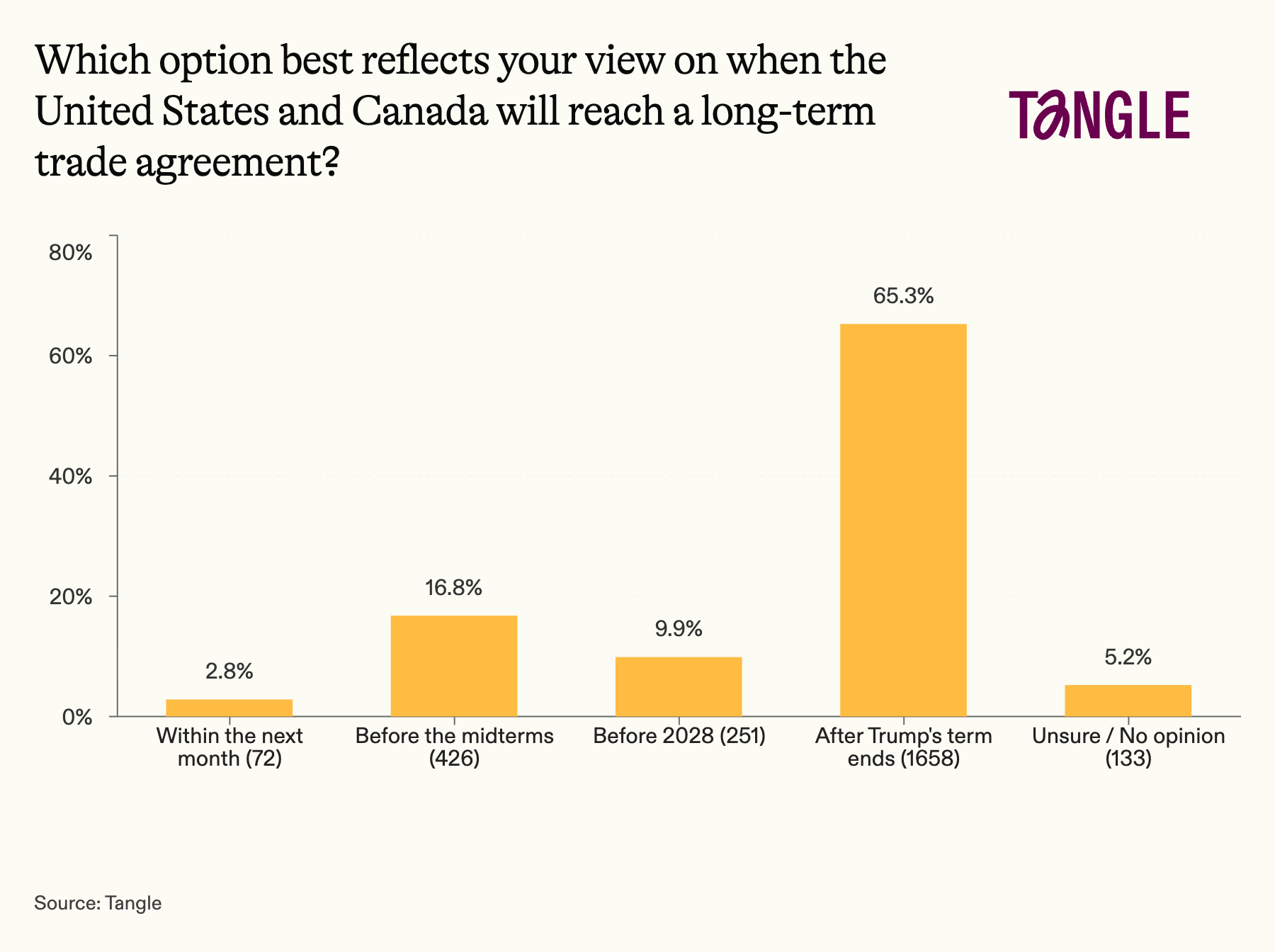
- Our last survey: 2,540 readers responded to our survey on the escalating U.S.–Canada trade war, with 65% saying they think the countries will reach a long-term trade agreement only after President Trump’s term ends. “You cannot negotiate in good faith with this administration,” one respondent said. “Canada has been ripping off the U.S. with their own tariffs for years. About time the U.S. pushes back,” said another.
Have a nice day.
The Spokane, Washington, area was devastated by wildfires in August, with over 10,000 acres burned and tens of thousands of residents forced to evacuate. One local business, JK Boots, transformed its headquarters into a relief center for firefighters responding to the blazes. The bootmaker provided food, drinks, showers and space to rest and recharge, while also coordinating supply donations from other locals. Furthermore, the company gave away countless pairs of its boots — which normally sell for $575–$700 — allowing firefighters to trade in old or destroyed pairs for brand-new ones. “We just wanted to do anything that we could,” Tim Khadzhi, one of JK Boots’s owners, said. “With this disaster hitting our hometown, when it’s so close, it just feels a lot different.” Good Good Good has the story.