

















 500,000+ readers just today.



Mitch McConnell’s health concerns.
Good Thursday morning. The weekend is nigh. I’m Isaac Saul and I can’t stop thinking about this line from a recent article in The Atlantic about the decline of literacy: “Nearly 30 percent of American adults cannot paraphrase or make inferences from a multipage text.” Should I quit writing this weekend or wait a few years?
If anyone is reading this, today we’re exploring questions about Mitch McConnell’s health and Congress’s broader problem with age. Plus, the stories we almost covered this week and some major updates from the Graham Platner campaign. It’s a 13-minute read, or if you’re done with reading, you can check out our podcast.
Audrey joins the pod.
In this week’s episode of Suspension of the Rules, Associate Editor Audrey Moorehead dropped into Managing Editor Ari Weitzman’s chair while he enjoys paternity leave. We discussed the Graham Platner scandal, whether he would actually drop out (we got our answer last night), and why we think the allegations are credible. Then, we talked about Mitch McConnell’s mysterious health issues (a topic we dive into today). It’s worth your time:
Quick hits.
- Maine Senate candidate Graham Platner (D) announced he will end his campaign, two days after a former girlfriend accused him of raping her in 2021. Platner said the allegation was untrue and claimed the Democratic establishment had undermined his candidacy. The Maine Democratic Party must now select a new nominee by July 27. (The announcement)
- The U.S. military launched a new round of strikes against Iran following President Donald Trump’s declaration that the U.S.–Iran ceasefire is over. (The strikes)
- President Trump said he will permit Ukraine to co-manufacture Patriot missile interceptors, a key resource to defend against Russian ballistic missile strikes. (The permission)
- Apple announced it will invest approximately $30 billion in chip manufacturing in the United States as part of a partnership with chipmaker Broadcom. (The investment)
- President Trump reportedly flew back to the United States from the North Atlantic Treaty Organization summit in Turkey on the old Air Force One aircraft after the Secret Service advised him not to use the new Air Force One, which was gifted by Qatar, as a security precaution. (The report)
The Best Sleep of Your Life — Guaranteed
You’re exhausted… but as soon as your head hits the pillow, your brain won’t turn off.
Or maybe you finally fall asleep… only to wake up at 2:37 AM staring at the ceiling.
For millions of people over 35, the problem isn’t just stress, blue light, or bad luck — it’s a simple mineral deficiency.
Organixx Magnesium 7 is the complete magnesium solution, with seven highly absorbable forms that target every pathway your body uses for relaxation and recovery.
The result?
- Fall asleep in minutes
- Stay asleep for hours
- Wake up feeling like you’re 20 again
Today’s topic.
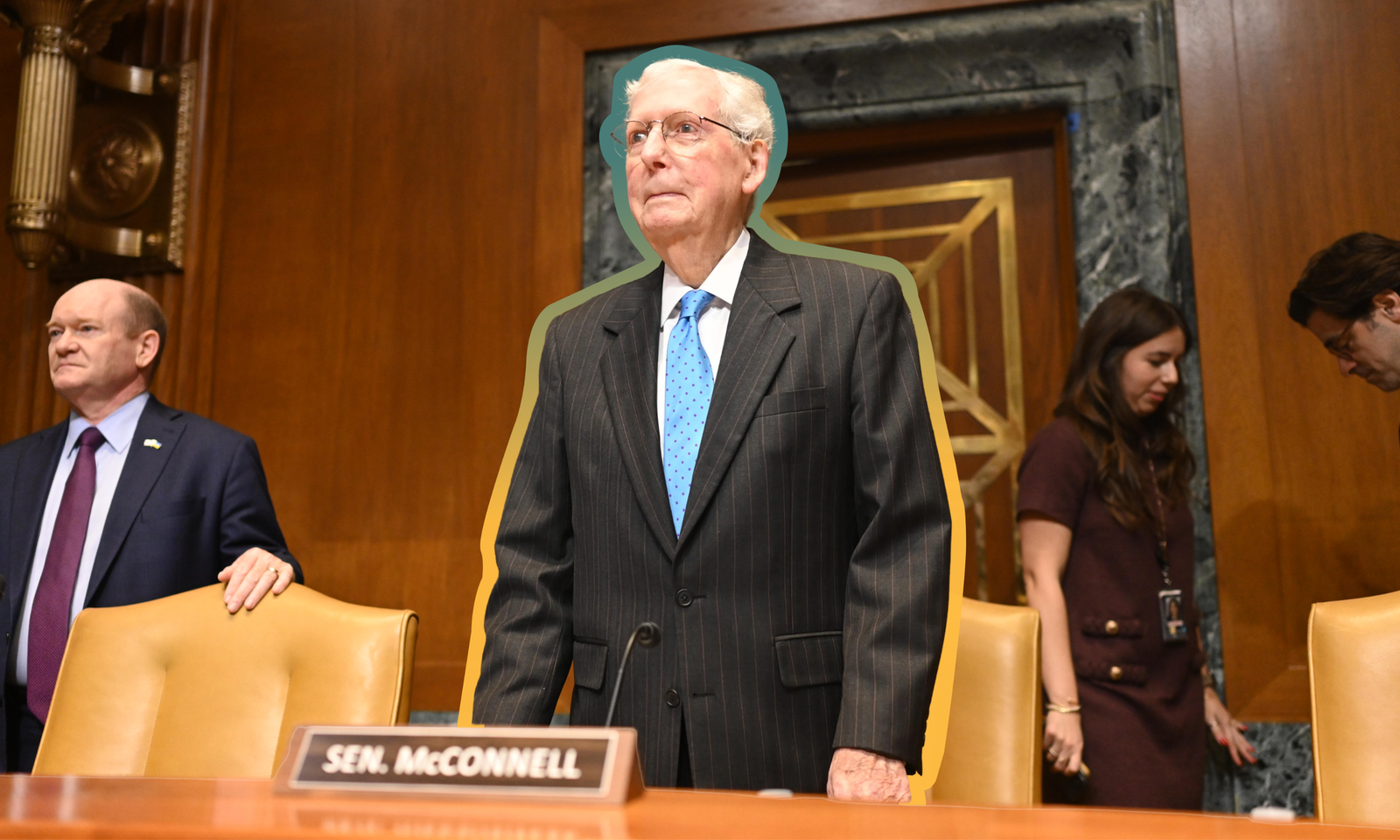
Mitch McConnell’s health. Over the past week, lawmakers have expressed increasing concern about Sen. Mitch McConnell’s (R-KY) health, roughly three weeks after the senator was hospitalized for still-unknown reasons. The hospitalization is the latest in a string of health-related incidents for McConnell, which have raised questions about his fitness for office. On Wednesday, Kentucky Gov. Andy Beshear (D) asked McConnell’s office to provide a “[full] update” on the senator’s status, citing increasing concern “about the current state of your health and wellbeing.”
Back up: McConnell, 84, is the longest-serving senator in Kentucky history and the 9th-longest-serving senator in United States history, first winning election to the chamber in 1984. He was the Senate’s majority leader from 2015 to 2021 and led the Senate GOP Conference from 2007 to 2025. His current term ends in January 2027, and he is not seeking reelection.
Major questions about McConnell’s health first arose in July 2023, when the senator abruptly stopped speaking while answering a reporter’s question and remained frozen for an extended period; he had a similar incident later that summer. Since then, McConnell has had multiple falls — some in public — resulting in serious injuries (he has said a childhood bout of polio has hindered his movements in adulthood). In February, he was hospitalized for over a week with what his staff called “flu-like symptoms.”
On June 14, McConnell was again hospitalized; earlier in the day, emergency responders reported performing CPR (cardiopulmonary resuscitation) on an individual experiencing cardiac arrest at the senator’s Washington residence, though they did not confirm that it was McConnell. His staff has yet to specify the nature of his hospitalization or his prognosis, but on July 2, they said he “continues to improve, and is working closely with his staff on Kentucky and Senate matters while the Senate is out of session.”
Separately, on Monday, right-wing activist Laura Loomer claimed that a source close to the Trump administration had told her that McConnell was “officially brain dead… [and] not coming back.” However, on Tuesday, spokespeople for Senate Majority Leader John Thune (R-SD) and Majority Whip John Barrasso (R-WY) said both lawmakers had spoken with McConnell this week and had substantive conversations. Former McConnell adviser and conservative political commentator Scott Jennings also said he had spoken by phone with McConnell for roughly 20 minutes on Tuesday.
If McConnell were to die or resign before the end of his term, a complex vacancy process would begin, potentially depriving Senate Republicans of a voting member until the November elections. The senator’s office has not indicated that he is in grave health or considering resigning at this time.
Today, we’ll share perspectives from the left and right on McConnell’s health, followed by Executive Editor Isaac Saul’s take.
What the left is saying.
- Many on the left view the mystery about McConnell’s well-being as a sign of an unhealthy democracy.
- Some suggest that concerns over the senator’s absence are overblown.
- Others say McConnell’s lack of transparency is unacceptable.
In The Daily Beast, Michael Ian Black argued McConnell’s situation is “even worse than we think.”
“Imagine if you just disappeared from your job for a month. Would you still expect to retain it? Would it be an insult for your employers to ask where the hell you are, or to ask for some proof that you’re recovering in the hospital from some ailment?” Black asked. “There are three options on the table here: either McConnell is alive and recuperating, in which case it ought to be easy enough for him to send a freaking Snapchat; he’s dead and not recuperating, in which case the law demands a special election; he’s in a vegetative state and unable to fulfill his duties, in which case the law demands a special election. So why don’t we know which it is?”
“Like everything with McConnell, the reason for this is as obvious as it is infuriating. Kentucky Republicans are almost certainly trying to drag out McConnell’s proof-of-life as long as possible in order to deny Kentucky voters the opportunity to hold an election to replace him,” Black said. “In a functioning republic, the first question citizens ought to be able to answer for themselves is the simplest one imaginable: are they alive? The fact that we can’t says less about the health of one Mitch McConnell, and much more about our own.”
In the Louisville Courier Journal, Joseph Gerth said the “specifics on Mitch McConnell’s health don’t matter.”
“If McConnell’s family and staff want to say exactly what is going on with him… they can do that if they want,” Gerth wrote. “I don’t know if they necessarily need to, though. I say this because McConnell is not the president of the United States. Whether or not a president can carry out his duties is of utmost importance. A senator? Not so much. He’s one of 100. The Senate will be fine while McConnell’s gone. It will be fine if he never returns. Just like it’s been fine when every other aging senator has fallen ill and spent time away from the Senate.”
“If [McConnell resigns,] we really don’t know what that means. It used to be that the governor would appoint a replacement who would serve until after the November election. But then the Republicans in the General Assembly, worried that McConnell would die in office, started to muck around with the law in an effort to keep Andy Beshear from appointing a Democrat,” Gerth said. “I suspect if McConnell dies or retires because he can’t do the job, this whole thing will end up in court. Even if Beshear succeeds in appointing a replacement, the victory will be short-lived… Until then, I don’t really care if McConnell’s office tells us exactly how he’s doing or what he’s up to.”
In his Substack, Ken Klippenstein wrote “Mitch McConnell nears dead-line.”
“In a political system run by the sage leaders that people like McConnell imagine themselves to be, he would have stepped down so voters could have an orderly election and decide for themselves. Instead, we have a mad dash for partisan power,” Klippenstein said. “Lawmakers [have] stayed almost completely silent about McConnell’s unexplained absence for more than two weeks. During that stretch he missed more than 20 votes, including a knife-edge resolution to curb Trump’s war powers over Iran. The reason is simple: nobody wants to invite scrutiny of health and fitness in a gerontocracy, especially when members on both sides of the aisle have something to hide.”
“Whatever the truth of his condition, McConnell — or his aides — have decided the public doesn’t deserve to know what’s going on. Yet by their own account, a handful of officials do deserve to know, as well as one insider who worked for McConnell,” Klippenstein wrote. “Scott Jennings, a former McConnell staffer turned political commentator and one of the few non-government figures who claims to have spoken with him, was asked about the silence on CNN and said: ‘Ultimately, these officeholders — you know, they’re in charge of their own operations.’ They’re in charge. Not the four million Kentuckians who have no idea if half their Senate representation is even conscious. Not the 300 million Americans who have to live under the decisions he and his colleagues make.”
What the right is saying.
- Many on the right say McConnell’s health challenges are serious but not yet grave.
- Some say McConnell dying or stepping down before August 3 could upend the GOP caucus.
- Others suggest that Congress needs stronger requirements for lawmakers’ continued participation.
In RedState, Jennifer Oliver O’Connell suggested that speculations about McConnell’s health “have been greatly exaggerated.”
“Like or dislike McConnell, this stuff about his health condition is not only crazy town, but downright ghoulish,” O’Connell wrote. “Occam’s Razor, folks: The simplest and most reasonable explanation is probably the right one. McConnell is 84-years old and has had major health challenges and scary falls of late. Hence, part of the reason why he will be retiring once his term is done… So this unexpected hospital visit and stay could well be for extensive testing and monitoring out of an abundance of caution. At his age, it is not uncommon or unsurprising.”
“In terms of his Senate seat, unless it is vacated — whether because of incapacity or death — McConnell is the sitting senator from Kentucky. Full stop,” O’Connell said. “What all this disbelief, speculation, conspiracy theories, and prognostication indicate is that it doesn’t matter whether it’s the Democrat or Republican side of things; few have faith in the ability of their elected officials to be honest about the state of affairs in their party. Even when party leaders attempt to respect privacy and maintain decorum (e.g., in the case of Republican Rep. Thomas Kean, Jr. (NJ-07) and his months-long battle with depression), we assume the worst because it usually is.”
In Reason, Robby Soave said the Republican establishment “needs McConnell to hold out until August 3.”
“McConnell is retiring, and the standard election to replace him will happen in November,” Soave wrote. “But that’s November. What if, God forbid, McConnell doesn’t make it until then? Well, in that case, Kentucky would have to hold a special election to fill the seat. Kentucky is one of a handful of states in which the governor can’t just appoint a temporary replacement: It would need to schedule a special election. And anybody could file to run as an independent in that election.”
“This only applies if it became clear that McConnell needed to be replaced before the cutoff date of August 3… At that point, the seat would simply be empty, and McConnell’s replacement would be determined via the normal November election. And it’s too late for [Rep. Thomas] Massie or anyone else to run as an independent in that one,” Soave said. “It may very well be the case that McConnell’s final political gambit is to try to deny Massie the opportunity to channel grassroots outrage into a successful Senate run. And if that’s what’s going on, foes of the establishment have just under a month to unmask this conspiracy.”
In The Federalist, Chris Bray wrote “Congress can’t require members to show up or quit.”
“A member of Congress who wins a seat holds the seat, and gets the paycheck, until he loses an election or decides to give it up. He doesn’t have to come to work to have the job,” Bray said. “Members of Congress have medical privacy rights, but their constituents have a right to be represented. The conflict between those competing rights keeps coming up… In the most recent examples, Rep. Tom Kean, a New Jersey Republican, stopped coming to work for four months, offering no explanation for his absence.”
“Not participating in deliberation while serving in deliberative bodies, and not providing representation while holding office in a representative government, members of Congress who wander away from the job face no immediate consequences,” Bray wrote. “They hold the seat long after they lose their ability to do the work. To change that, we would have to get Congress to act. You can see how likely that is.”
My take.
Reminder: “My take” is a section where we give ourselves space to share a personal opinion. If you have feedback, criticism or compliments, don't unsubscribe. Write in by replying to this email, or leave a comment.
- I hope McConnell is okay, but he should resign.
- Congress’s age-related issues are only getting worse.
- I don’t see a clear resolution to this problem unless lawmakers like McConnell lead by example and step down when they can no longer do the job.
Executive Editor Isaac Saul: Sen. Mitch McConnell is a human being, so every piece of writing about his health should start with some well-wishes: I sincerely hope rumors about him being brain dead or actually dead are false, and I wish him a speedy and full recovery.
That said, McConnell should obviously resign.
Knowing this is a sensitive subject, and having fielded repeated accusations of “ageism” for my early warnings about President Biden’s declining mental acuity in 2021, I want to state clearly: I’m not advocating for age limits in Congress, nor am I sure how much good they would even do. Not all octogenarians or nonagenarians are created equal: My grandmother lived to be 97, and she was mentally fit enough in her final days to do just about any task (a real blessing). Yet the halls of Congress are replete with members in their 70s, 80s or 90s who simply aren’t up for the job anymore, and lawmakers seem to have such a desperate need to hang onto power that it’s genuinely rare for any of them to give it up voluntarily. My grandmother had the capacity to work and the grace to know her limits. Congress today too often has neither.
Consider the recent examples: Sen. Dianne Feinstein (D-CA) spent the last few years of her life in Congress avoiding members of the press while her staff covered up her inability to do the job. Her memory was so bad that she regularly expressed confusion about basic Senate functions, once asking why Vice President Kamala Harris was presiding over the chamber for a tiebreaking vote. Staff members would whisper in her ear and hand her notes the moment before votes, seemingly guiding her through the decision-making process.
Eleanor Holmes Norton (D), the non-voting D.C. delegate, is now 89 years old. She has seemed hardly capable of interacting with reporters for several years now — yet refuses to resign. Last year, she was scammed out of several thousand dollars by con men posing as house cleaners, and a police report on the incident said she was in the “early stages of dementia.”
Former Rep. Kay Granger (R-TX), 83, missed months of votes in 2024 before we found out she’d been suffering from dementia and living in an assisted-living facility. Just this spring, Rep. Frederica Wilson (D-FL), 83, missed almost a month of votes, did zero press, and gave no updates on her health; when she re-emerged in Congress, she said a left-eye surgery had prevented her from flying. A couple weeks later, she said she wouldn’t run for reelection — but would still serve out her term.
Five members of the 119th Congress have died in office since January 2025: Rep. Sylvester Turner (D-TX) died after a medical emergency at the age of 70, Rep. Raúl Grijalva (D-AZ) died of complications from lung cancer treatment at the age of 77, Rep. Gerry Connolly (D-VA) died of esophageal cancer at the age of 75, Rep. Doug LaMalfa (R-CA) died of an aortic dissection at the age of 65, and Rep. David Scott (D-GA) died at 80 of undisclosed causes following years of speculation about his health. Also, Rep. Sheila Jackson Lee (D-TX) died of pancreatic cancer at the age of 74 in July 2024, right as the 118th Congress was wrapping up; the next month, Rep. Bill Pascrell (D-NJ) died at the age of 87 following a prolonged hospitalization.
This Congress is on pace to surpass the number of deaths in each of the past five congressional sessions. The overall death numbers from the past decade or so have also ticked up compared to the decade prior.
All this serves as context for the recent Mitch McConnell episode, and all available evidence suggests the senator had some kind of major cardiac incident at his home, collapsed, had to be revived by emergency responders, and has spent the last three weeks in a hospital bed. We know virtually nothing about his current status, which presents its own transparency problem. With that said, I do not trust the “journalist” Laura Loomer, who reported that McConnell is brain-dead. Loomer is more of a right-wing activist than a reporter, whose own brain is so addled by conspiracies that she has accused sitting senators of affairs based on selfies they took with their wives. I certainly trust her less than conservative commentator Scott Jennings and Senate Majority Leader John Thune (R-SD), both of whom have said they’ve spoken to McConnell in recent days; obviously, holding conversations with colleagues or friends is not something “brain-dead” people typically do.
Yet this is not some one-off incident. If McConnell were in his 40s, 50s, or 60s — or were in his 80s but with a totally clean health record and the acuity of someone like, say, Sen. Bernie Sanders (I-VT) — I might advocate giving him the time and space to recover. But that is not the situation we have. For all the talk of President Biden’s fitness throughout his term, much of which I participated in, the former president never froze in public without speaking or moving for over 20 seconds. Just go watch the videos of that happening to McConnell twice in the span of a month in 2023 and let me know if you think he’s up for the job (that was three years ago, and I was calling for him to step down then, or for Congress to institute term limits).
Those “freezing episodes,” which were always an oddly euphemistic name for what looked like back-to-back medical emergencies, are the sort of incidents that would prompt you to rush a parent, friend, or colleague to the hospital — and then take their car keys. McConnell has also had several falls recently and is regularly seen on camera (much like the late Sen. Feinstein) receiving direct instructions from his staff on his movements, actions, and statements. Anyone who has spent time with the elderly recognizes these signs as indications that a person needs extra care at home — the kind of care I think it’s fair to say a member of Congress should not need to receive while serving.
Pointing this out is so taboo that the few reporters who do typically get an onslaught of angry emails from Congressional staff and even other reporters. So, let me repeat: This is not about age; it’s about the capacity to do the job. While age limits aren’t a terrible solution to this problem, they’re also not particularly democratic. I think allowing voters to elect elder statesmen they trust is fine, or putting term limits on everyone (regardless of age) is also workable, but I don’t necessarily think an age limit targeting the elderly is the best option.
I can also empathize with someone like McConnell — whose career was mostly defined by being in control — not wanting to accept that his time has come, or resisting calls to step down. One day, God-willing, I’ll be in my 80s or 90s and maybe still writing publicly about politics; if it looks like I’m slipping, or incapable of doing the work without serious assistance, I hope there will be someone with enough wisdom around me to rip this keyboard from my cold, dead hands (and good luck to you). But that’s just it: The fact that nobody around McConnell has guided him to the exit at any point in the last few years is a genuine travesty — and it appears he nearly died in office just months before his long-delayed retirement.
There is a fine line between respecting your elders, or respecting institutions like Congress, and ignoring natural issues that come with aging, and the press — and many political operatives — regularly seem to be on the wrong side of this one. McConnell is just one of many members of Congress who are holding onto their jobs too long, motivated either by their own clinging to power or the insistence of those around them that retiring will hurt their party politically (in this case, given McConnell’s history of procedural manipulation, I think it’s fair to wonder if he’s trying to avoid a special-election selected replacement for the last months of his term).
Whatever has led up to this point, the senator has an opportunity to lead by example, and he should. Rather than leave Republicans with an incapacitated member for the next month, or several months, he should resign now and let whatever process is supposed to play out play out. Anything less than that is just more ugly precedent for a very ugly and uncomfortable trend that has been ailing Congress for years.
Take the survey: Should we have age limits for Congress? Let us know.
Disagree? That's okay. Our opinion is just one of many. Write in and let us know why, and we'll consider publishing your feedback.
Numbers.
- 21. The total number of votes Sen. Mitch McConnell has missed since his hospitalization in June.
- 239 of 14,403. The proportion of roll call votes McConnell missed between January 1985 and June 2026.
- 1.7% and 2.8%. The percentage of roll call votes missed by McConnell during that period and the median percentage of votes missed by currently serving U.S. senators, respectively.
- 11.2. The average number of years of service for senators elected to the 119th Congress.
- 63.9. The average age of senators at the beginning of the 119th Congress.
- 80%. The percentage of U.S. adults who support imposing a maximum age limit for candidates running for the Senate or House, according to an April 2026 NPR/PBS News/Marist poll.
Your secret to (almost) free travel
Points travel is not magic, but when you use your points the right way, it can feel pretty close.
point.me helps total points beginners travel like pros. Their flight search tool finds the deals hiding inside airline loyalty programs, not just the obvious ones in your credit card portal. Search where you want to go, and point.me shows you how to book better flights with up to 90% fewer points, step by step.
Get 4 months free on an annual membership with code 4MONTHSFREE.
The road not taken.
We started the week debating whether to cover President Trump’s appeal to the Fédération Internationale de Football Association (FIFA) to lift the red-card suspension of U.S. soccer player Folarin Balogun to allow him to play in the team’s World Cup match against Belgium on Monday. FIFA did just that, and it sparked a global controversy, pushing this sports-centric story into the political realm. We held off on covering to see how the match went (and what Balogun’s impact would be); after the U.S. was handily beaten, the furor died down considerably, and we didn’t think the topic merited a full edition.
Otherwise, our coverage choices this week were fairly straightforward and dictated by the stories driving the most commentary on the right and left. Next week, we’ve got our eye on an Iran war update, President Trump’s NATO summit appearance, and the Michigan Senate primary as potential main topics on Monday or Tuesday. Another dark horse: Tucker Carlson’s announcement that he plans to help establish a new political party.
The extras.
- One year ago today we covered the Trump administration’s updates on investigations into Jeffrey Epstein.
- The most clicked link in our last regular newsletter was, once more, the link to vote for Tangle in the 2026 People’s Choice Newsletter Awards (thanks for your support!).
- Nothing to do with politics: A site that lets you surf television channels from past decades.
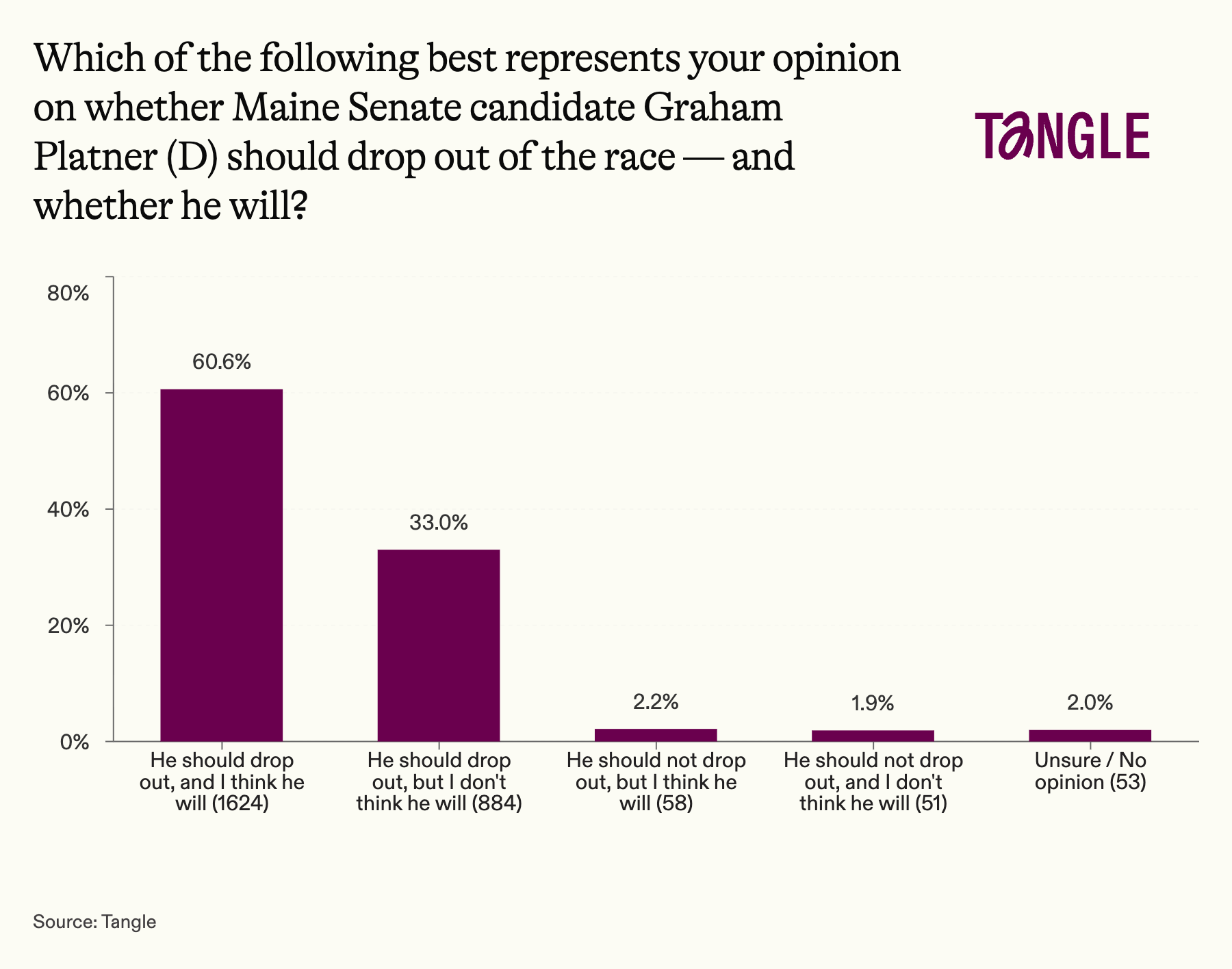
- Our last survey: 2,679 readers responded to our survey on the accusations against Maine Senate candidate Graham Platner (D), with 61% saying Platner should — and will — drop out. “Platner is finished and he should be,” one respondent said. “So everyone but Trump has to drop out [based] on allegations?” said another.
Have a nice day.
Among the provisions at Ethan, Seth and Jonathan Mielke’s lemonade stand at a farmer’s market in Rogers City, Michigan, were hand-painted rocks, fresh produce and, of course, homemade lemonade. The three brothers could count on between $100 and $200 each summer from their stand, but last season, they had to stop: The market’s new management told them that they would need a temporary food license to continue selling (costing nearly $400). Early this year, the boys delivered handwritten letters to state Rep. Cam Cavitt (R), who vowed to work on the issue. He introduced HB 6007, a bipartisan bill that would allow minors to run lemonade stands that made $5,000 or less a year. On June 25 — two weeks after the brothers testified at a committee hearing — the state House unanimously passed the bill. The Washington Post has the story.